Most famous climbs start at the bottom. Sa Calobra starts at the top.
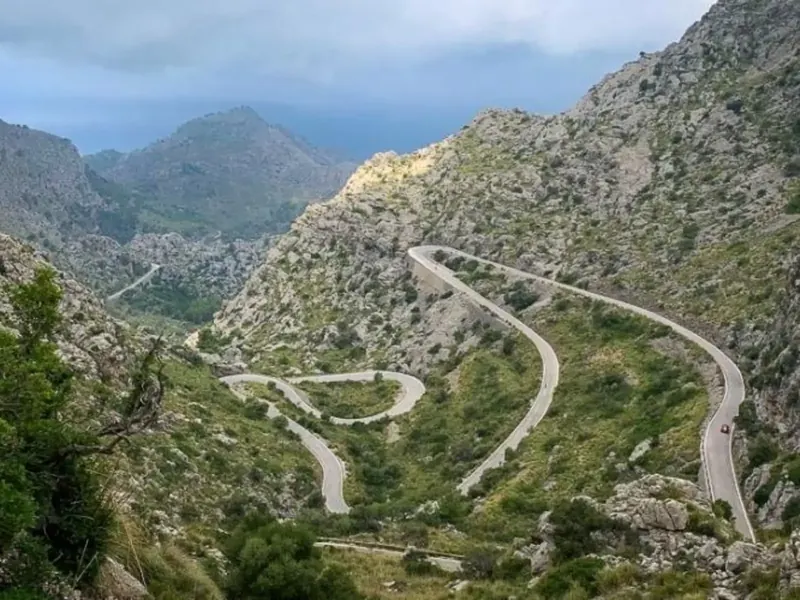
The road drops from the mountains of Mallorca's north-west coast to a tiny port of the same name, and stops there. There is no other way out. So the ride begins with a long, swooping descent to the sea, and every hairpin you lean through on the way down is one you will climb back up. Riders tend to remember the descent for exactly that reason.
A road built to reach a village
Until 1932, the village of Sa Calobra could only be reached by boat. That year the road down to it was opened, designed by the engineer Antonio Parietti and built by hand, without heavy machinery, through the limestone of the Serra de Tramuntana.
Parietti's idea was not to force a road down the mountain but to let it fall the way the terrain wanted. The result is one of the most celebrated pieces of road engineering in Europe, and the most famous section is near the top: the Nus de sa Corbata, the "tie knot", where the road turns through 270 degrees and passes under itself through a gap in the rock.
There is a neat connection for anyone riding a week in Mallorca. Parietti also designed the road from Port de Pollença out to Cap Formentor, several years earlier. Ride both in the same week and you have ridden the two roads on the island that one engineer is best remembered for.
The climb in numbers
From the port, Sa Calobra climbs about 9.4 km at an average of around seven per cent, through 26 hairpins by the most common count. The gradient is remarkably consistent. Parietti kept it steady rather than throwing in steep ramps, which makes it a climb you can pace well if you start sensibly.
Consistent is not the same as easy. It is widely regarded as the toughest climb on the island, and the steady gradient means there is nowhere on it to recover. Settle into a rhythm on the first hairpins and hold it; riders who attack the bottom tend to pay for it in the second half.
Before any of that, you climb briefly from the main mountain road to the Coll dels Reis, where the descent begins. It is also where the climb back up finishes.
Ride it early
Sa Calobra is one of Mallorca's best-known sights, not only for cyclists, and the road is narrow: in places too narrow for vehicles to pass each other easily. Coaches, cars and motorbikes all use it. Ridden early in the day, before the traffic builds, both the descent and the climb are far more enjoyable, and the descent in particular is safer.
Take the descent carefully regardless. The hairpins are tight, the drop is long, and there is a climb waiting at the bottom that will punish any energy spent braking hard at the last moment.
Sa Calobra on our Mallorca camp
On our Mallorca camp, Sa Calobra gets its own day: Day 5, 95 km with 2,130 metres of climbing, the biggest day of the week. It comes straight after a rest day in Port de Pollença, which is where it belongs, and it finishes in Alaró, our base for the rest of the week.
Around it, the week takes in most of what makes Mallorca worth flying to:
Day 2. Out to Cap Formentor on Parietti's other road, 68 km and 1,131 m.
Day 3. Up to the monastery at Lluc, 75 km and 880 m.
Day 7. The Coll de Sóller, Deià and Valldemossa, 77 km and 1,260 m.
Day 8. To the monastery at Cura, 74 km and 810 m.
Across seven riding days it comes to 506 km and 7,104 metres, averaging 72 km and 1,015 metres a day. We stay four nights in Port de Pollença and four in Alaró.
When to go
Sa Calobra is not a winter climb, and Mallorca's summer is hot for this kind of riding. Spring and autumn are the seasons, and our camp usually runs in April and October.
Riding from India, the Schengen visa sets the real deadline for a European camp, and our visa timeline works back from the day you fly. Our other Spanish camp is in Girona, whose two defining climbs are Rocacorba and Els Àngels.
The full itinerary is on the Mallorca Cycling Camp page. Dates are not yet on sale; leave your name there and you will hear first.
Written by Barnowl Adventures.