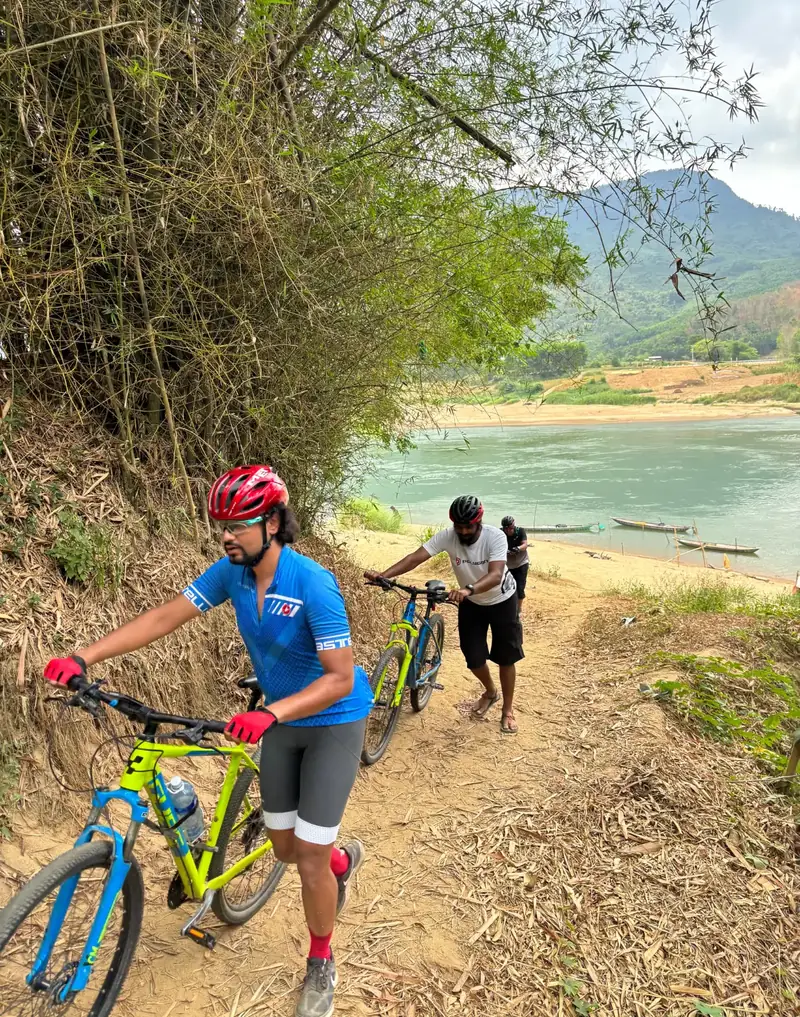
Vietnam · Hoi An to Hue
Vietnam Cycling Tour
Cycle Vietnam’s hidden heart
- Days
- 10
- Distance
- 438
km - Climbing
- 5,791
m - Group
- 8–12
- Grade
- Intermediate
The ride
About this tour
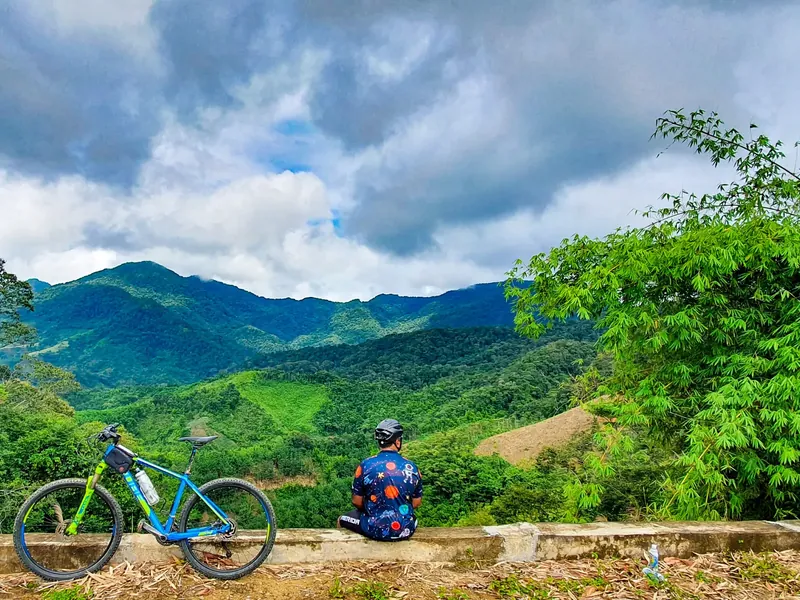
“This is a remote and pristine corner of Vietnam, right on the border with Laos. One gets the feeling, when looking out over the misty mountains blanketed in wet tropical foliage, that this is a special, somehow magical place.”
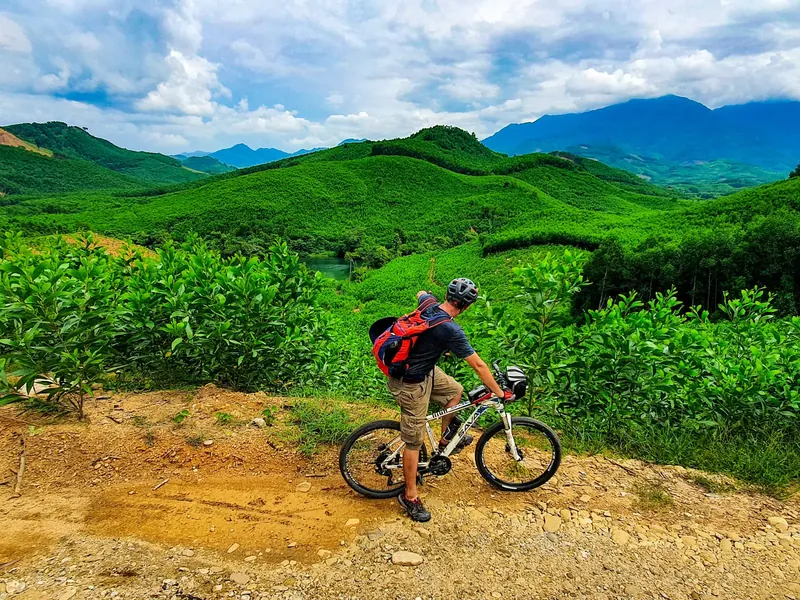
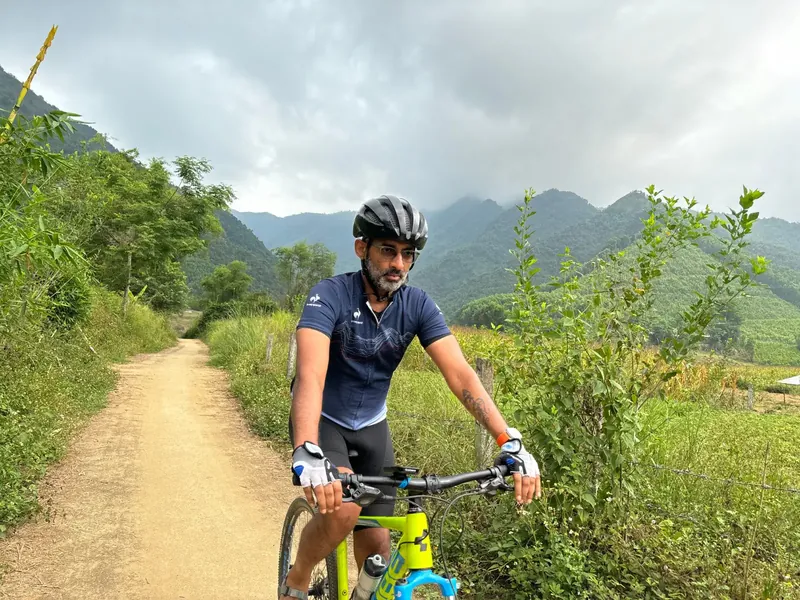
The Vietnam Adventure takes us far beyond the busy cities and well-known tourist routes into one of the most beautiful and least-visited regions of Central Vietnam. Starting in the historic trading port of Hoi An, we ride through rice paddies, fishing villages, river valleys, and remote mountain landscapes before finishing in the former imperial capital of Hue.
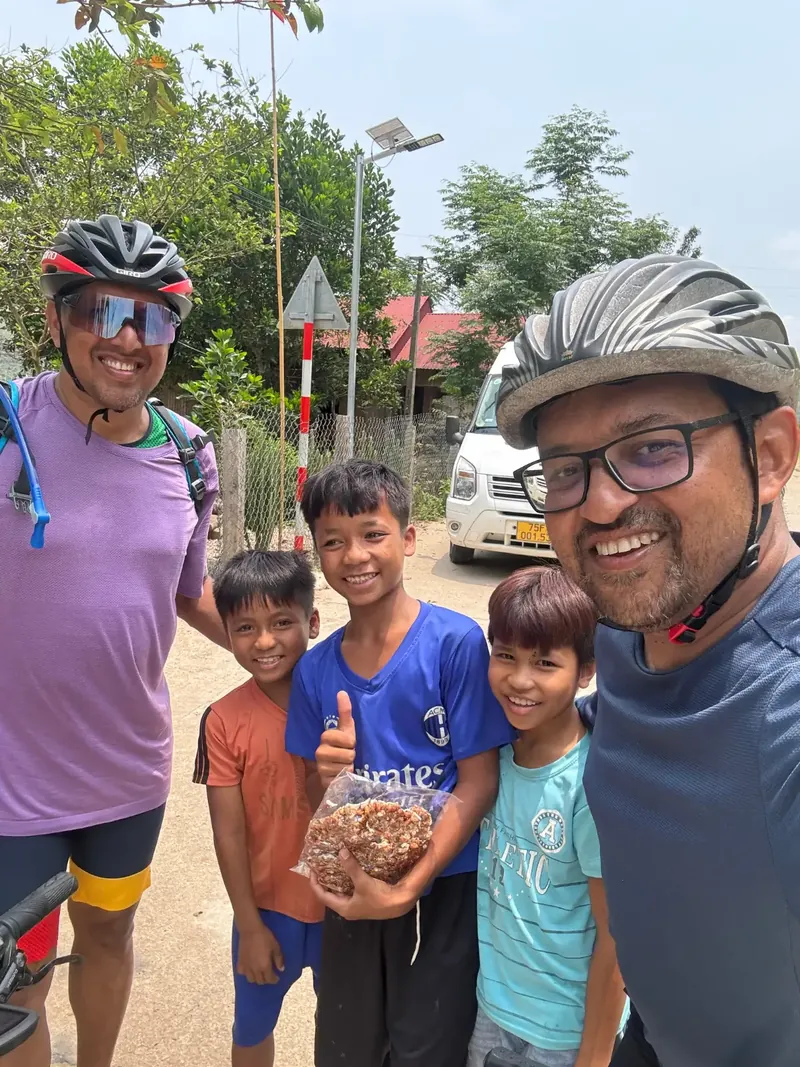
This is as much a journey through Vietnam as it is a cycling tour. Along the way we’ll cross rivers on local ferries and chartered boats, visit hidden waterfalls, ride sections of the legendary Ho Chi Minh Trail, and spend time in villages that remain largely untouched by tourism. We’ll experience Vietnam’s vibrant coffee culture, warm hospitality, and extraordinary food while travelling through landscapes that few visitors ever get to see.
This isn’t a training camp or a performance-focused cycling holiday. It’s a journey through one of the most fascinating and least-visited regions of Vietnam, where the journey, the people, and the places are every bit as memorable as the riding itself.
The shape of the week
438 km
5,791 m up
Each bar is one day's climbing.
- Arrive
- 76m 76m
- 341m 341m
- 710m 710m
- 540m 540m
- 690m 690m
- 1,208m 1,208m
- 1,421m 1,421m
- 805m 805m
- Depart
- D1 — —
- D2 31 km 31 km
- D3 77 km 77 km
- D4 60 km 60 km
- D5 54 km 54 km
- D6 52 km 52 km
- D7 44 km 44 km
- D8 70 km 70 km
- D9 50 km 50 km
- D10 — —
Highlights
What you'll
remember
Ride from lantern-lit Hoi An to historic Hue through some of Central Vietnam’s most scenic backroads.
Explore remote mountains, river valleys, and villages far beyond the usual tourist routes.
Experience memorable crossings and hidden gems, including local ferries, boat rides, and a secluded waterfall.
Cycle sections of the legendary Ho Chi Minh Trail near the Laos border, surrounded by spectacular mountain scenery.
Day by day
The itinerary
Day 1 Hoi An: Lanterns & Ancient Streets No riding
- Distance
- —
- Climbing
- —
- Night stay
- Resort in Hoi An
- Meals
- Dinner
The day
Meet the group in Da Nang before a short transfer to Hoi An, one of Vietnam’s most atmospheric towns. A UNESCO World Heritage Site, Hoi An was once one of Southeast Asia’s most important trading ports. Today, its lantern-lit streets, historic merchant houses, riverside cafés, and vibrant food scene make it one of the country’s most charming destinations.
After checking in, we’ll spend some time assembling bikes and setting up the rental bikes. Saddle heights, cockpit adjustments, and a short test ride ensure that everyone is comfortable and ready for the adventure ahead.
Later in the afternoon, there will be time to explore the old town before we gather for a tour briefing and welcome dinner.
Destination
Few places in Vietnam are as enchanting as Hoi An. Once a bustling trading port linking merchants from China, Japan, and Europe, the town has retained much of its historic character and easy-going charm. Its lantern-lit streets, centuries-old merchant houses, bustling markets, and riverside cafés make it one of the country’s most atmospheric destinations.
With a wonderful mix of history, culture, and food, Hoi An is the perfect introduction to Vietnam and a fitting place to begin our journey.
Highlights
- Group transfer from Da Nang to Hoi An
- Assemble bikes and dial in the rental bike setup
- Welcome dinner and tour briefing
Day 2 Beyond Hoi An 31 km76 m
- Distance
- 31 km
- Climbing
- 76 m
- Night stay
- Resort in Hoi An
- Meals
- Breakfast
The day
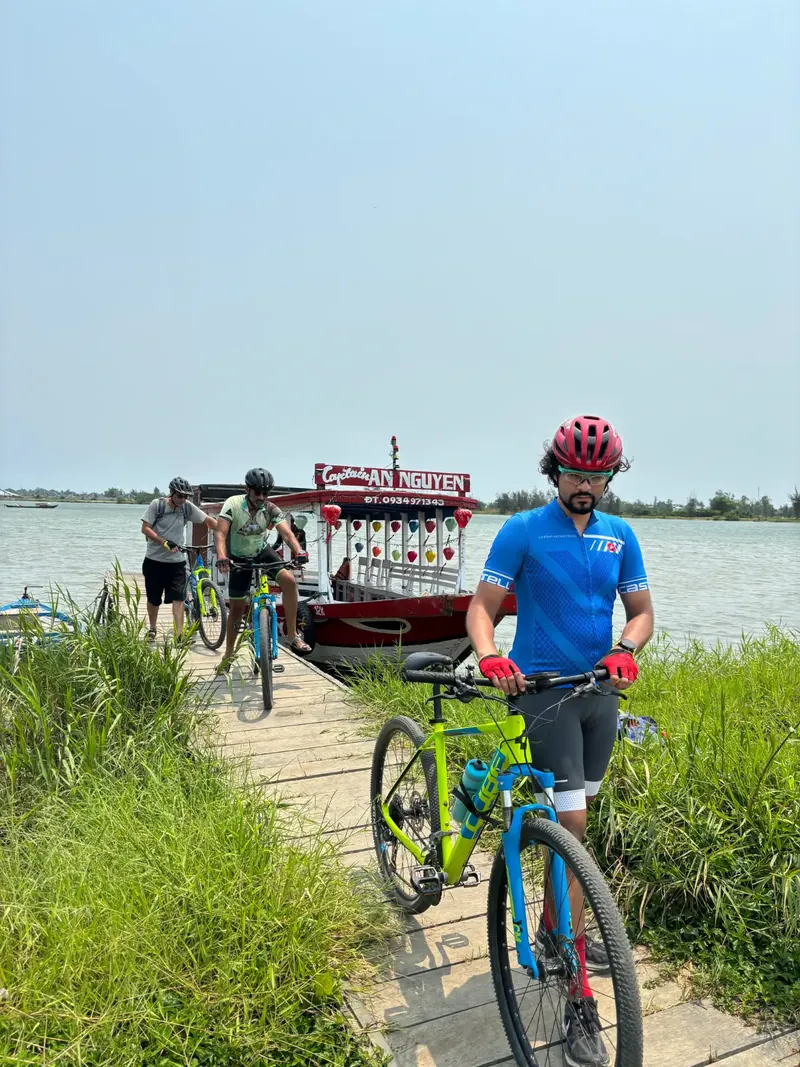
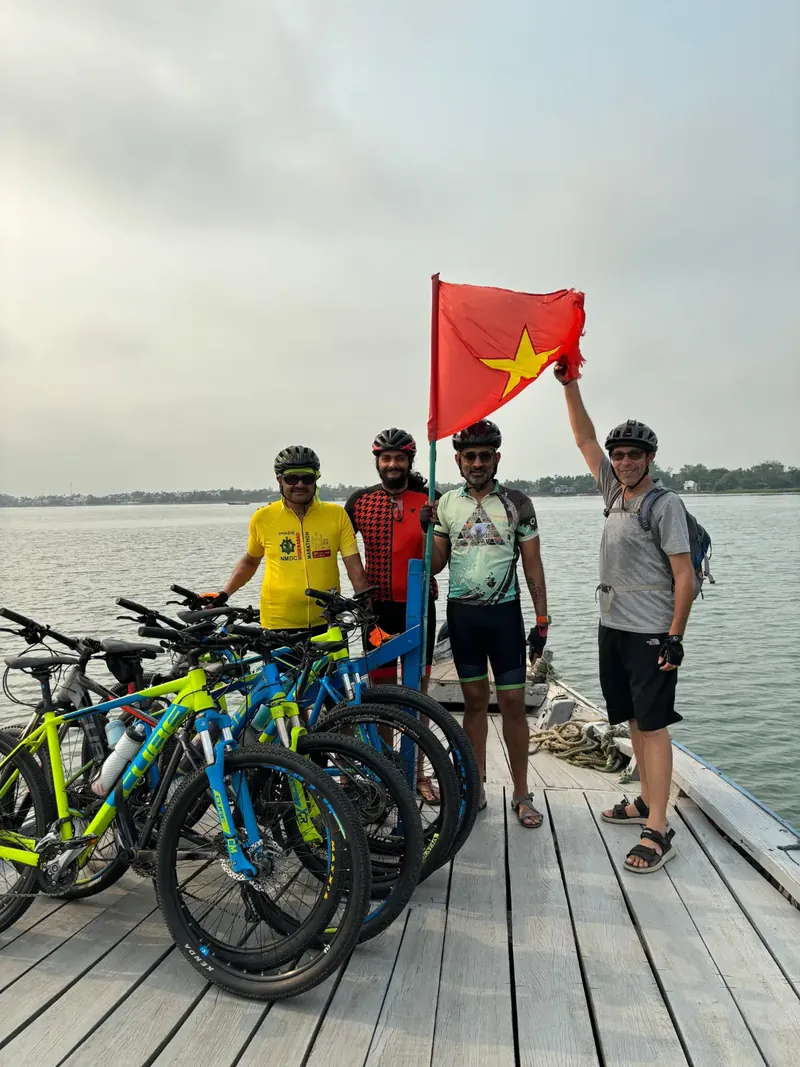
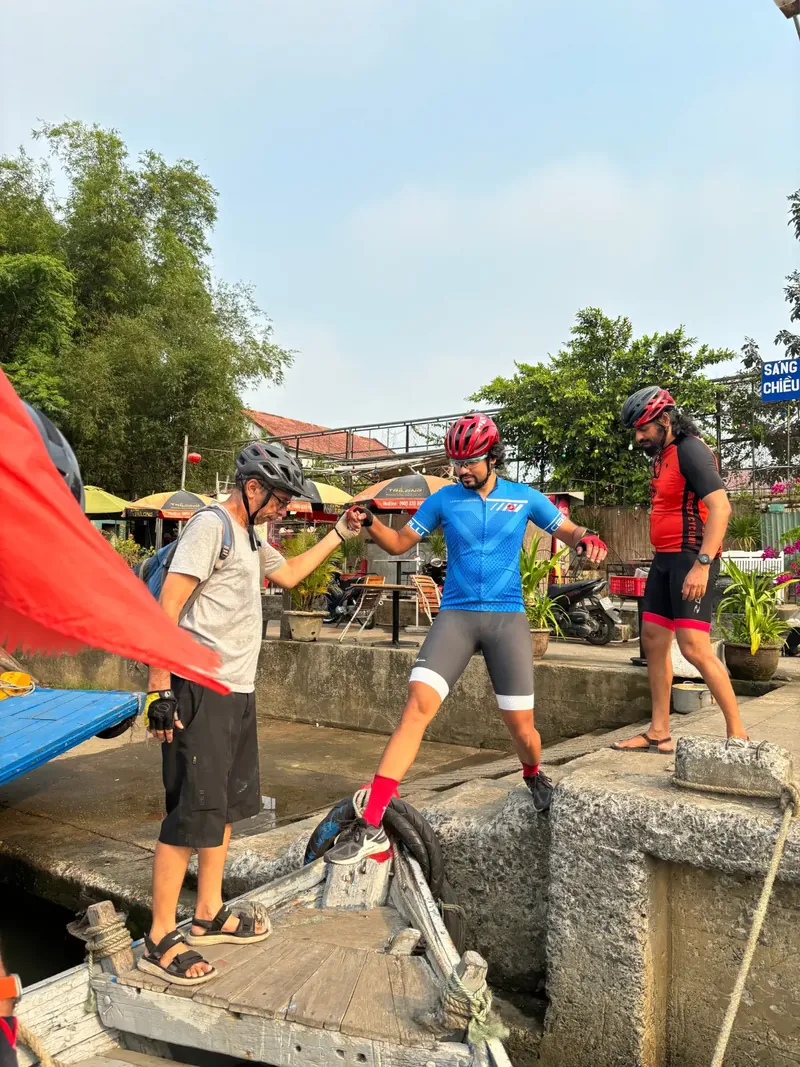
Our adventure begins with a ferry crossing over the Thu Bon River, leaving the bustle of Hoi An behind and entering a quieter world of rice paddies, fishing villages, and family farms. We ride through rural Vietnam, stopping at a local home to learn how traditional rice wine is made.
Back in Hoi An by lunchtime, the afternoon is free to enjoy the markets, cafés, and lantern-lined streets.
Highlights
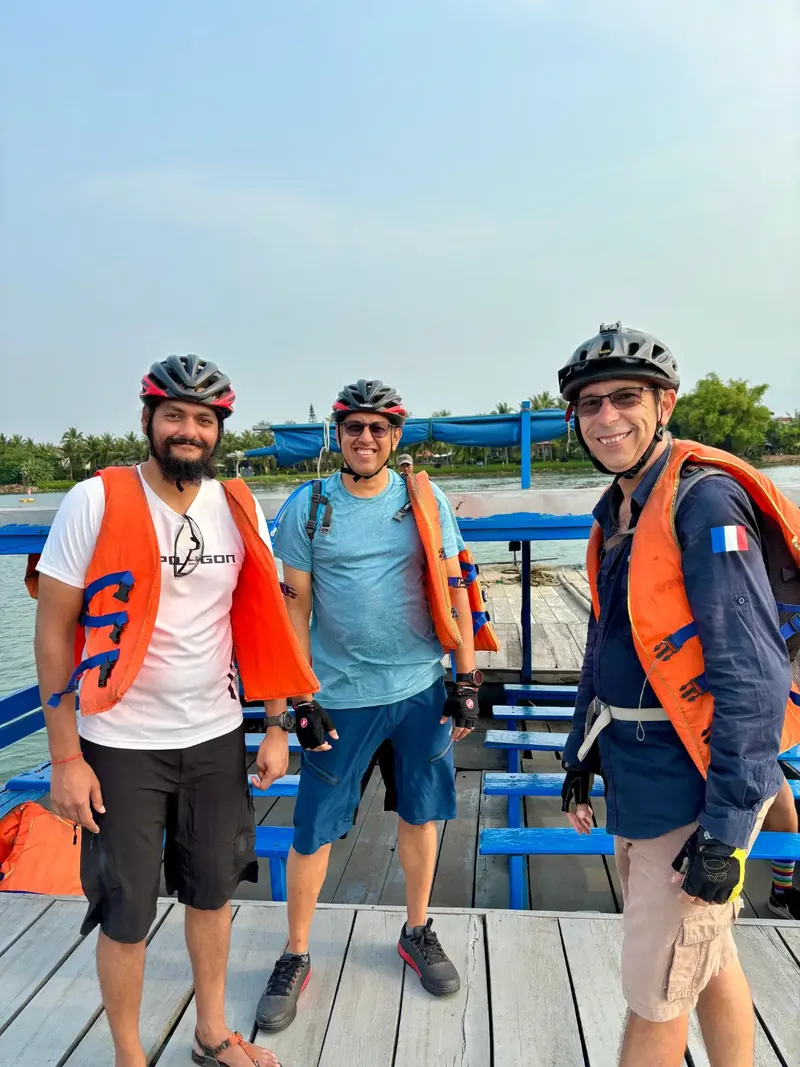
- Ferry crossing over the Thu Bon River
- Ride through rice paddies, fishing villages, and shipyards
- Stop for coffee at one of the ancestral Vietnamese homes
Day 3 The Coastal Ride 77 km341 m
- Distance
- 77 km
- Climbing
- 341 m
- Night stay
- Resort by the Lagoon
- Meals
- Breakfast, Lunch, Dinner
The day
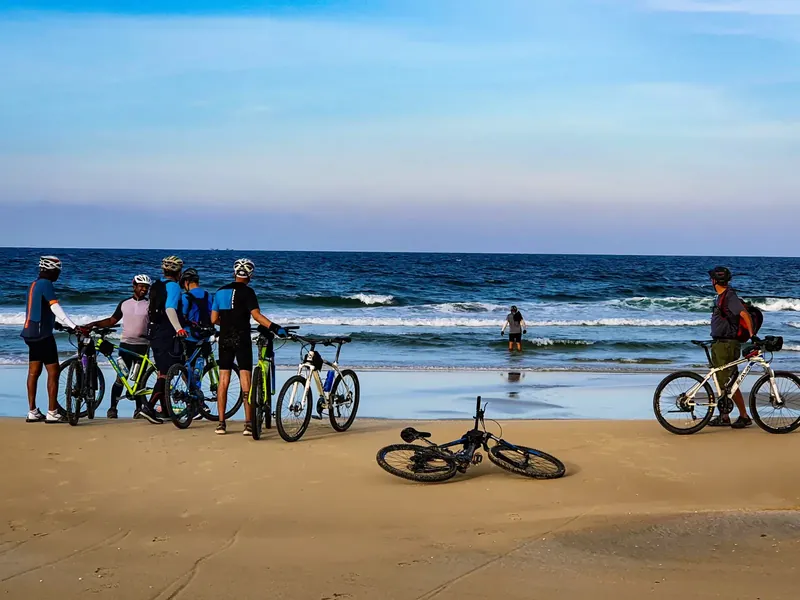
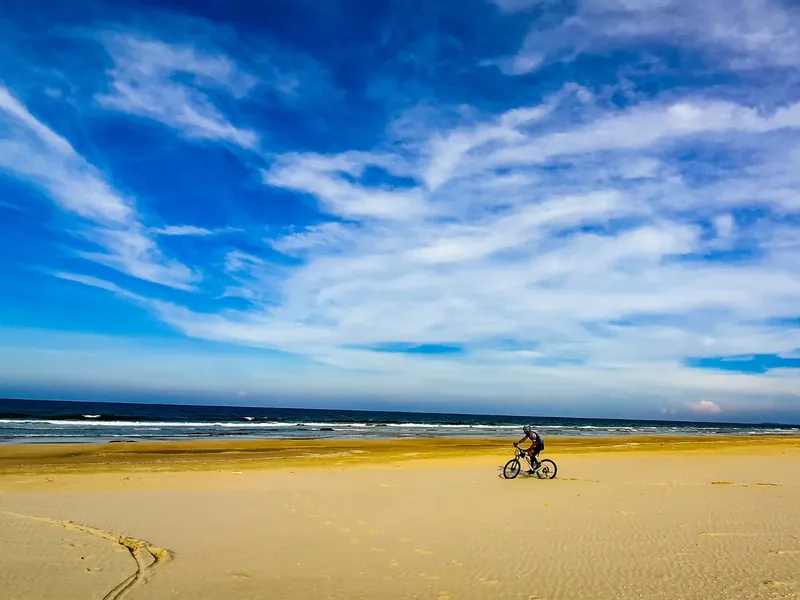
Today’s ride follows the coastline south of Hoi An, combining quiet roads, fishing villages, and long stretches beside the sea. Along the way we visit a remarkable tunnel complex built during the Vietnam War before continuing south to our overnight halt.
Destination
Tonight we stay beside a tranquil coastal lagoon. Far from the crowds, it is a peaceful corner of Vietnam where fishing boats drift across calm waters and life moves at a slower pace.
Highlights
- Scenic riding along Vietnam’s coastline
- Visit a fascinating wartime tunnel complex
- Overnight at a beautiful resort beside a peaceful coastal lagoon
Day 4 Vietnam Countryside 60 km710 m
- Distance
- 60 km
- Climbing
- 710 m
- Night stay
- Guesthouse
- Meals
- Breakfast, Lunch, Dinner
The day
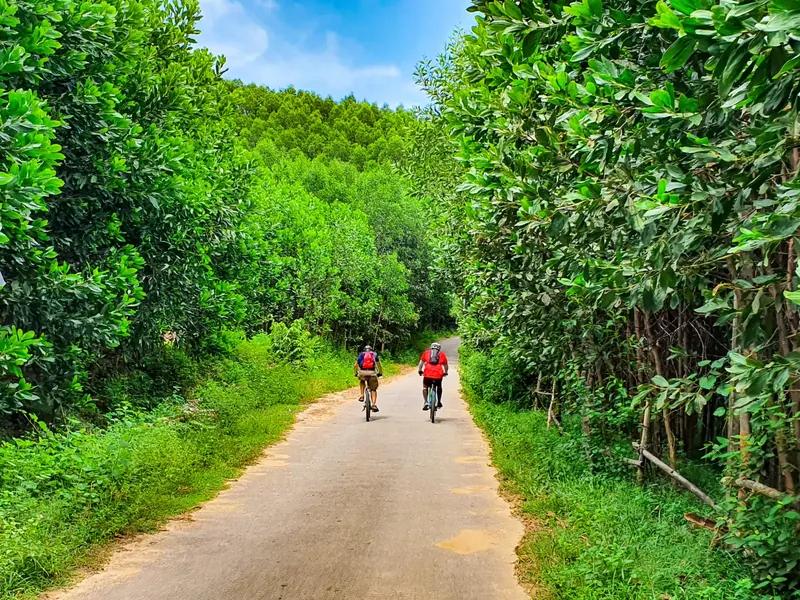
Two ferry crossings within the first hour set the tone for another memorable day. Leaving the coast behind, we venture inland through quiet farming communities and rolling countryside.
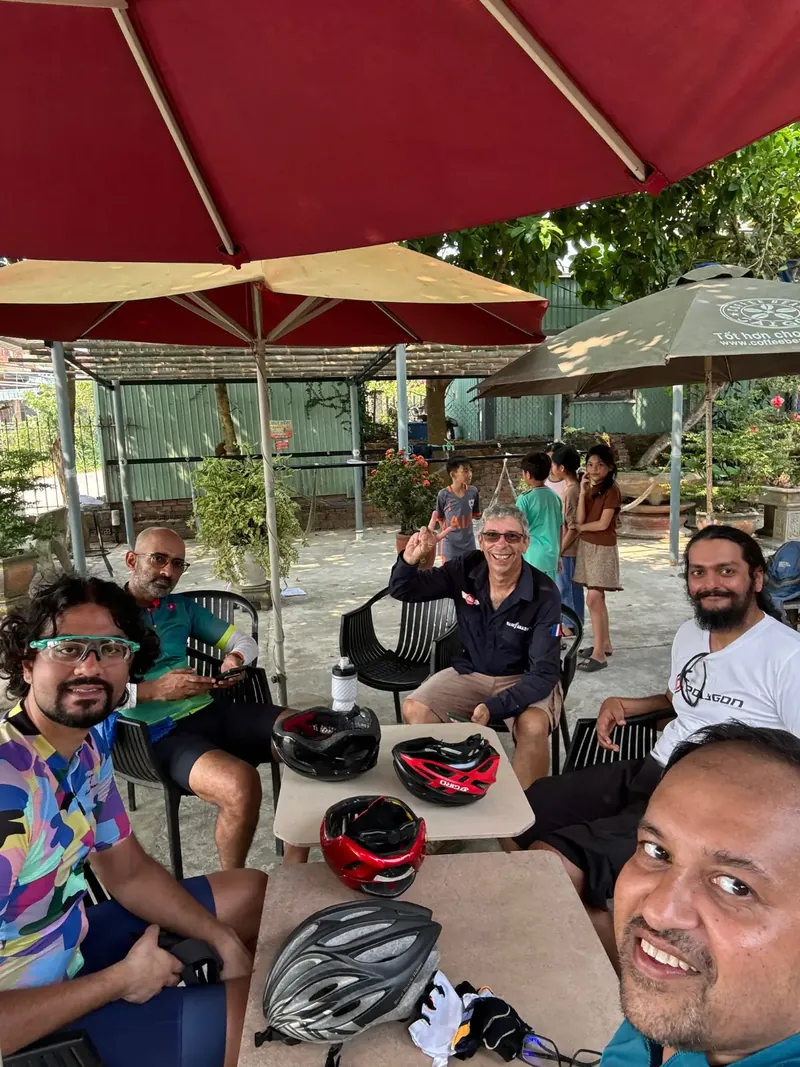
A refreshing swim at a natural spring and plenty of roadside coffee stops ensure that the pace remains relaxed and distinctly Vietnamese.
Destination
Our night halt is a simple guesthouse in the rural Vietnam, far removed from Vietnam’s busy tourist centres and surrounded by the gentle rhythms of the countryside.
Highlights
- Leave the coast behind and ride through rural Vietnam
- Cool off at a natural spring en route
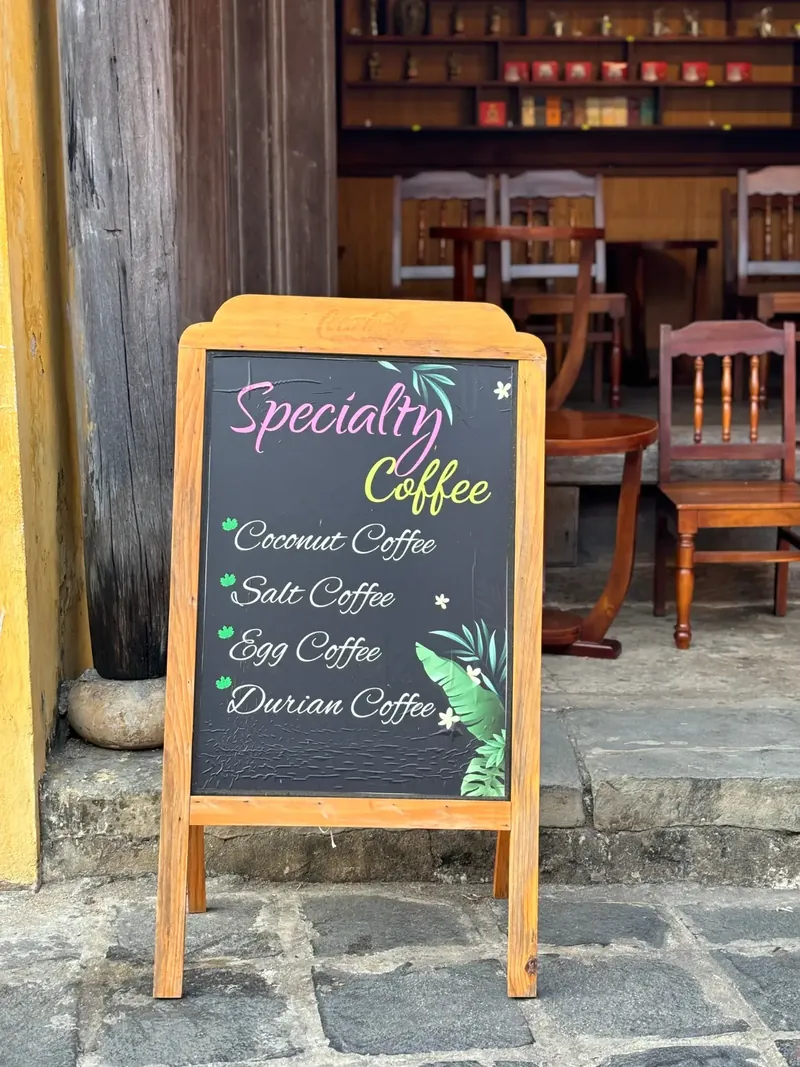
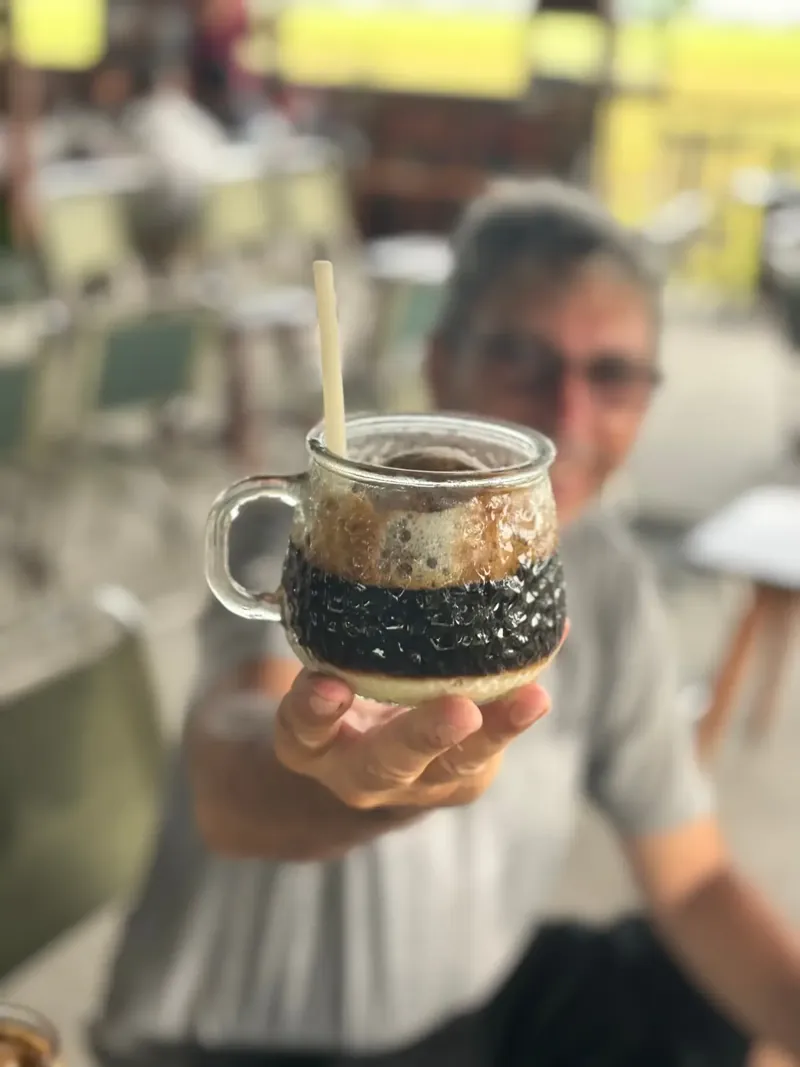
- Experience Vietnam’s café culture over a cà phê sữa đá or cà phê đen
Day 5 The Hidden Waterfall 54 km540 m
- Distance
- 54 km
- Climbing
- 540 m
- Night stay
- Guesthouse
- Meals
- Breakfast, Lunch, Dinner
The day
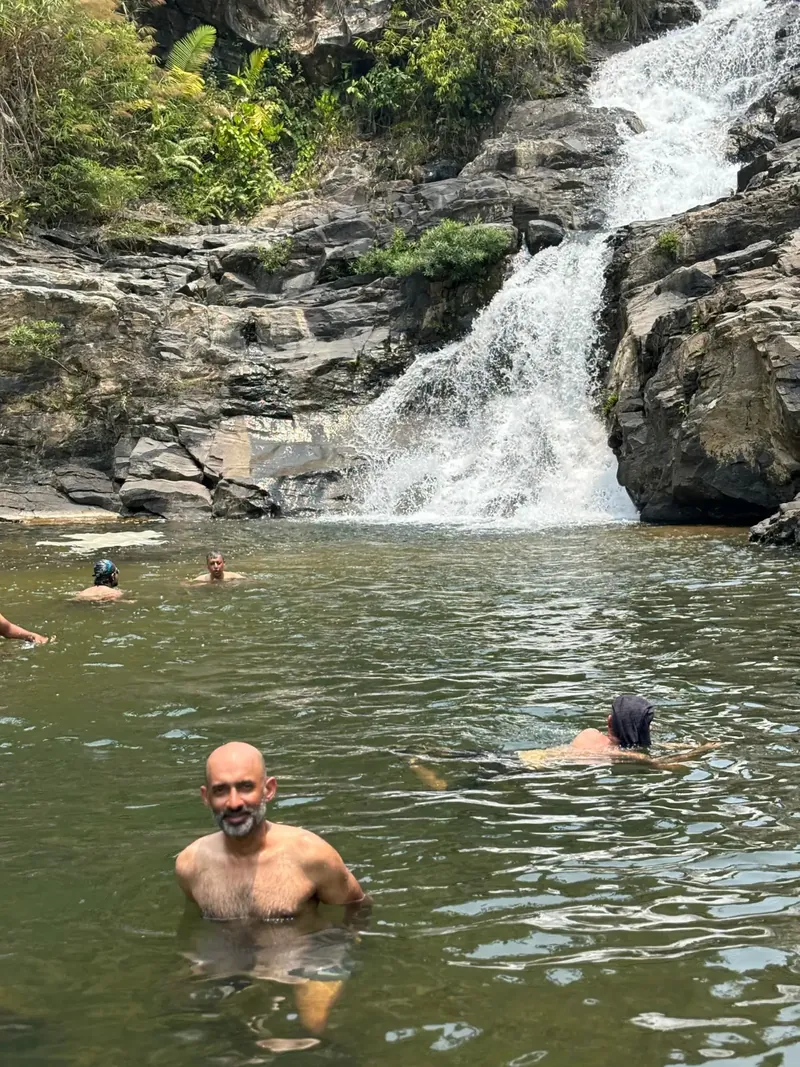
After a morning of rolling countryside and quiet backroads, we reach one of the hidden gems of the tour, a secluded waterfall reached by boat, where a refreshing swim awaits.
The afternoon follows a beautiful river valley road as we continue deeper into Central Vietnam. We finish our ride a little before our destination of the day and take 30-minute transfer to our hotel, avoiding the busier roads on the outskirts of town.
Destination
We stay at a small provincial town and our gateway to the more remote landscapes that lie ahead. From here, the journey gradually leaves mainstream Vietnam behind and ventures deeper into the country’s mountainous interior.
Highlights
- Boat ride to a hidden waterfall
- Swim in a secluded natural setting
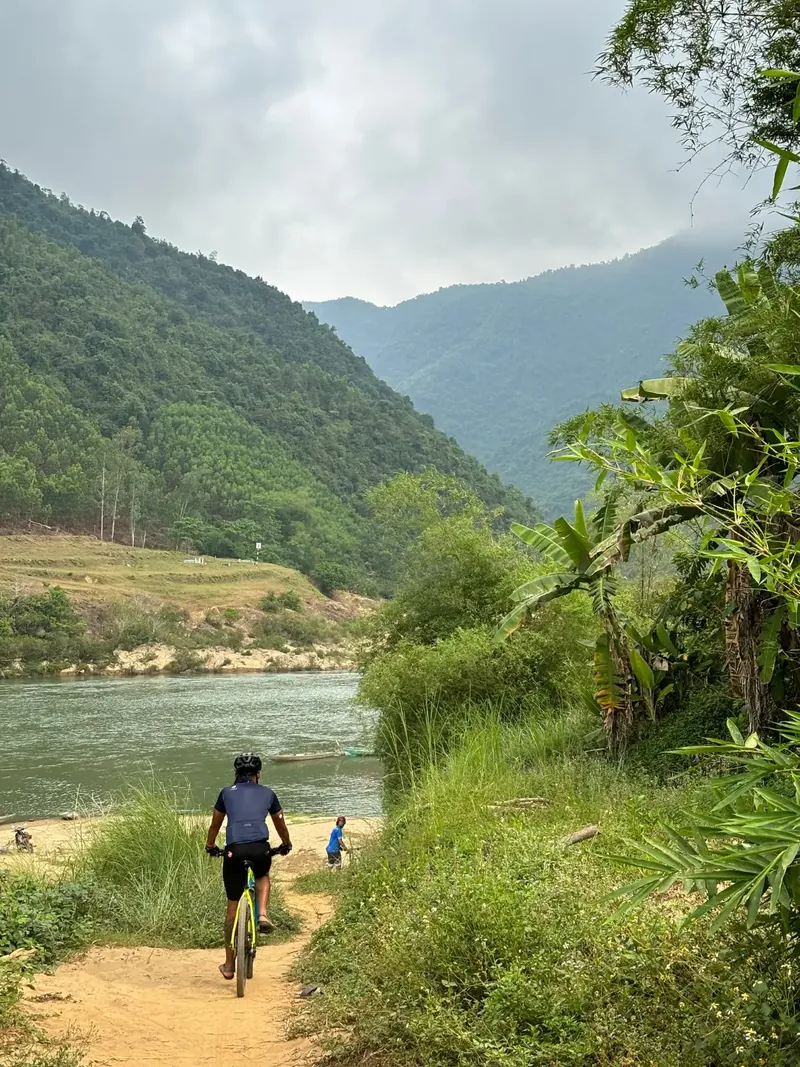
- Ride through beautiful river valleys
Day 6 Deep Into the Thu Bon Valley 52 km690 m
- Distance
- 52 km
- Climbing
- 690 m
- Night stay
- Guesthouse
- Meals
- Breakfast, Lunch, Dinner
The day
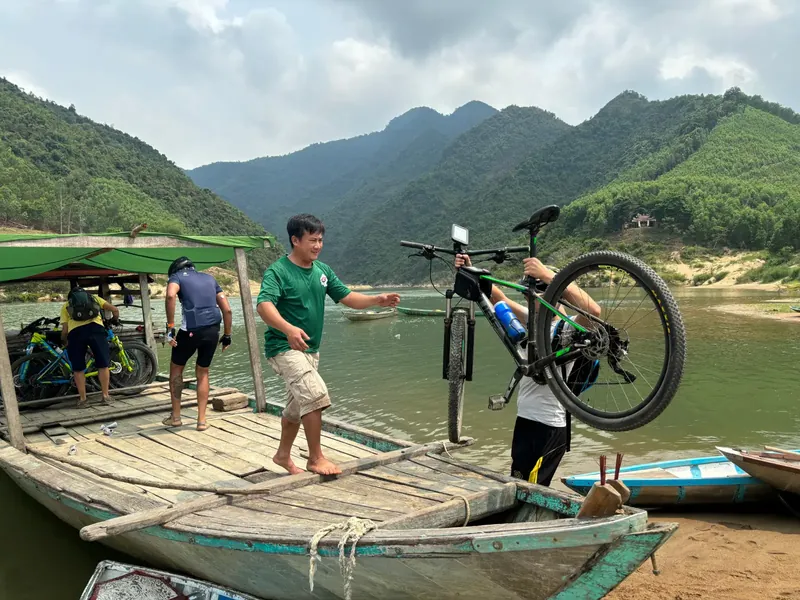
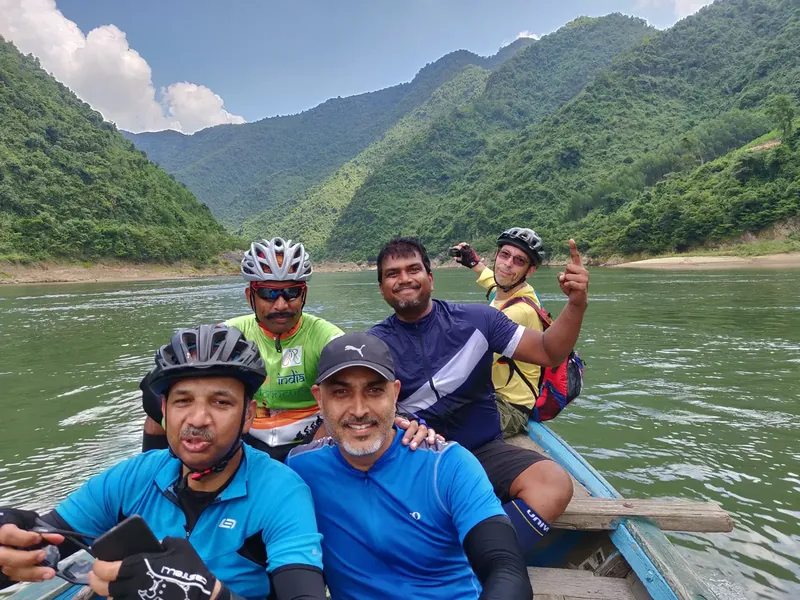
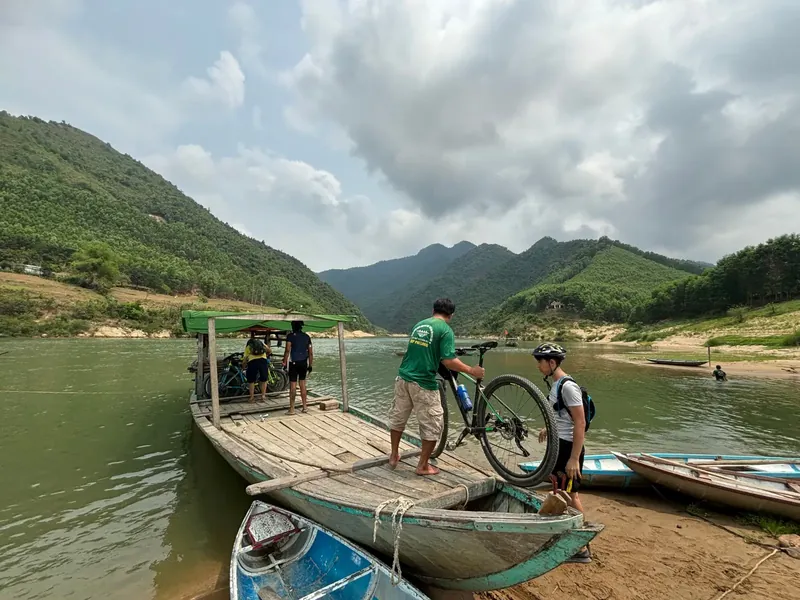
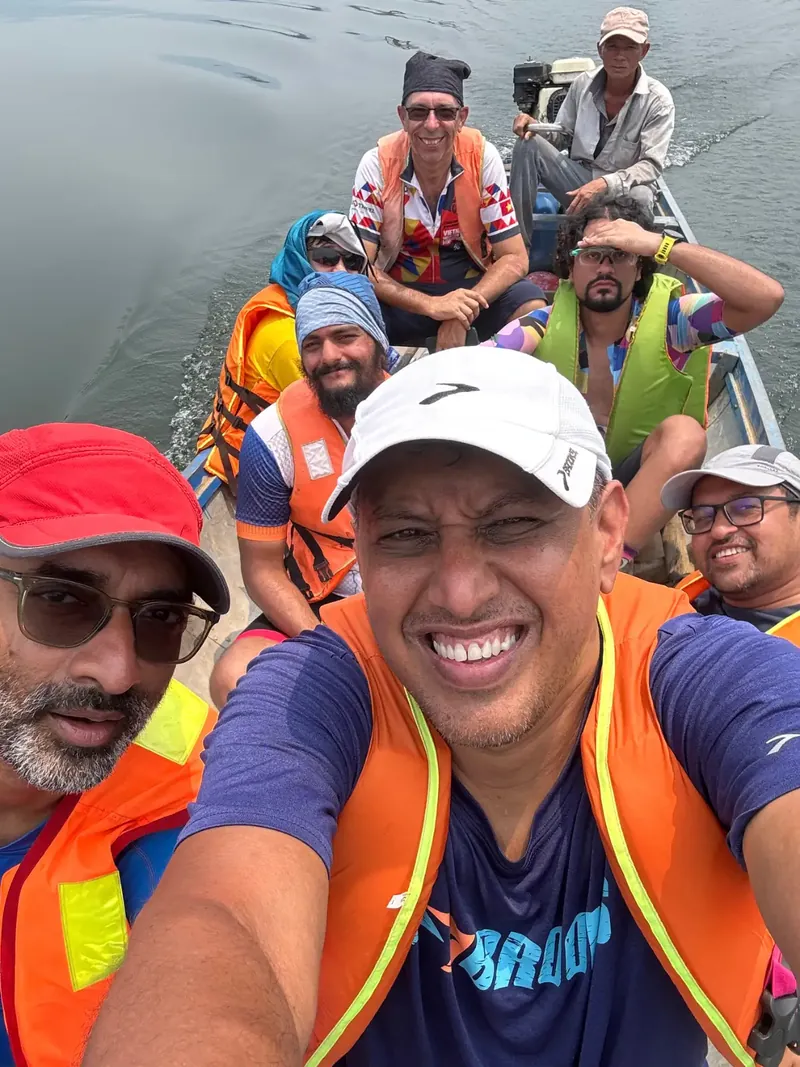
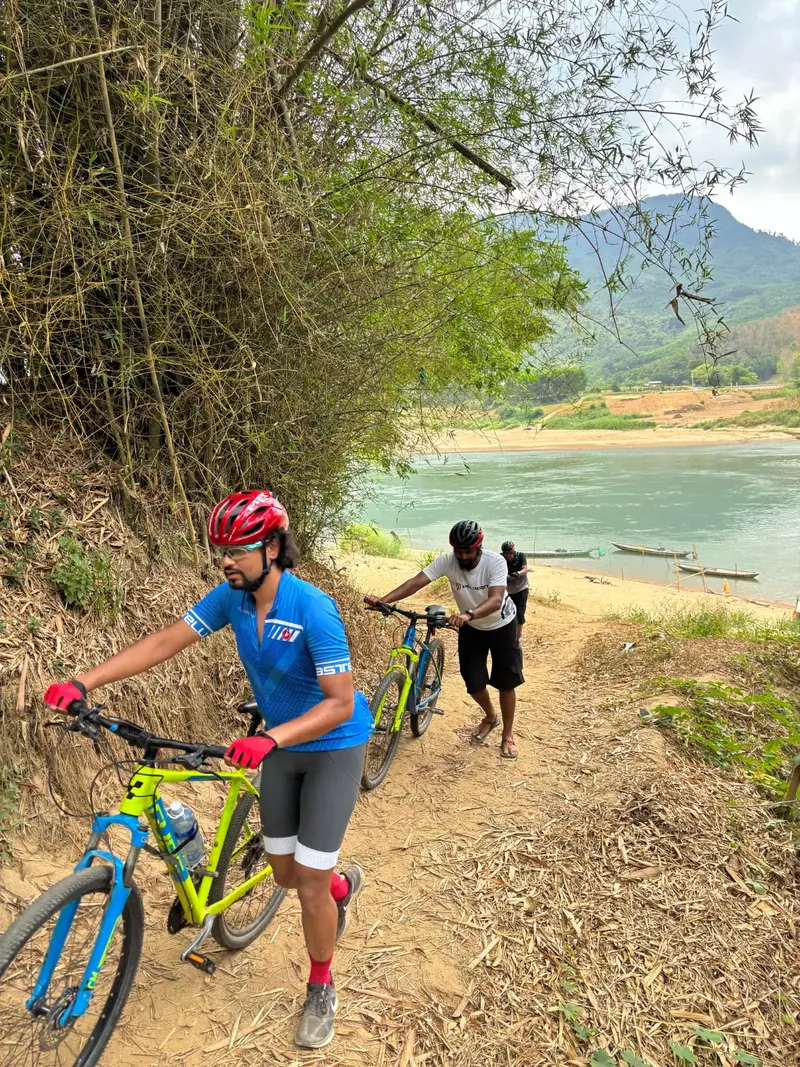
After a short transfer, we begin riding towards the Thu Bon Valley along beautiful country roads. Before long, the road gives way to the river, and bikes are loaded onto a local boat for one of the most memorable crossings of the trip.
On the other side, small villages, lush farmland, and quiet roads lead us deeper into one of the most beautiful corners of Central Vietnam.
Our destination tonight is a small guesthouse in Vietnam countryside. Set in the broad valley of the Thu Bon River, the town marks the transition between Vietnam’s fertile lowlands and the remote mountains that lie ahead.
Destination
Surrounded by rice fields and the gentle landscapes of the Thu Bon Valley, our destination is a peaceful rural town and the last taste of the lowlands before our journey heads deeper into Vietnam’s western frontier.
Highlights
- Memorable boat crossing through a canyon with the bikes
- Ride through remote villages and farmland
- Sample Mi Quang, one of Central Vietnam’s signature noodle dishes
Day 7 Into Remote Vietnam 44 km1,208 m
- Distance
- 44 km
- Climbing
- 1,208 m
- Night stay
- Guesthouse
- Meals
- Breakfast, Lunch, Dinner
The day
Today we enter some of the most remote and rewarding terrain of the entire tour. A short transfer brings us deeper into the mountains before we begin riding along the upper reaches of the Thu Bon River.
Road surfaces vary constantly, adding to the sense of adventure, while encounters with other travellers become increasingly rare.
Destination
Close to the Laos border, we spent the night at a remote mountain town where reminders of the region’s turbulent past coexist with a peaceful way of life and warm local hospitality.
Highlights
- Ever-changing roads and spectacular scenery
- Challenging terrain with long climbs
- Overnight in the remote mountain town of Tay Giang
Day 8 The Ho Chi Minh Trail 70 km1,421 m
- Distance
- 70 km
- Climbing
- 1,421 m
- Night stay
- Dorm-style Guesthouse
- Meals
- Breakfast, Lunch, Dinner
The day
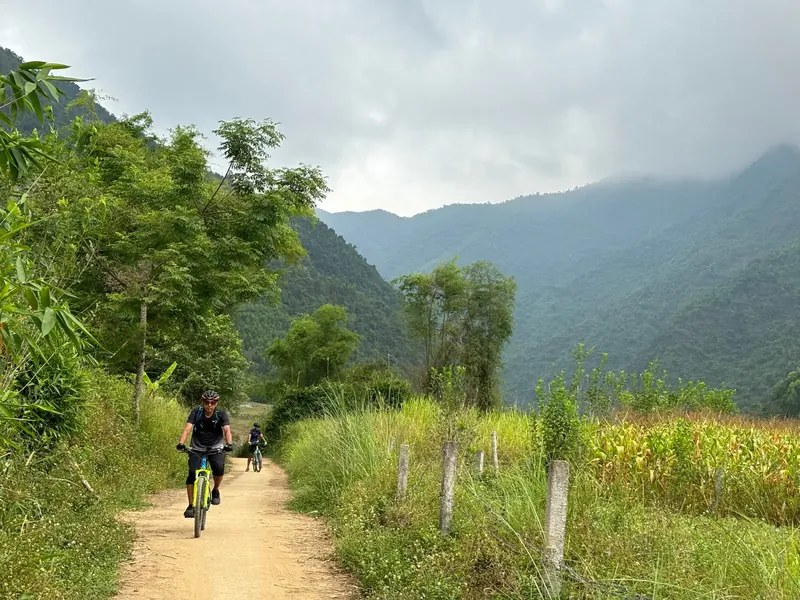
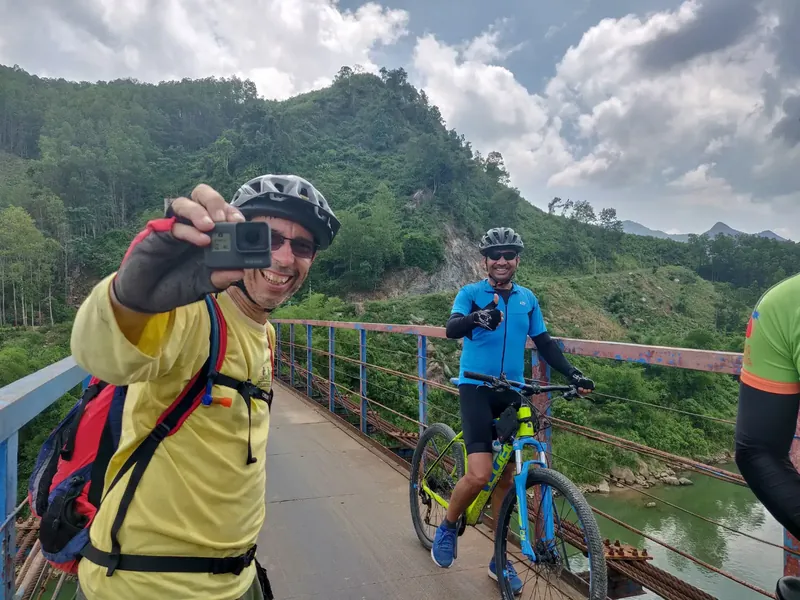
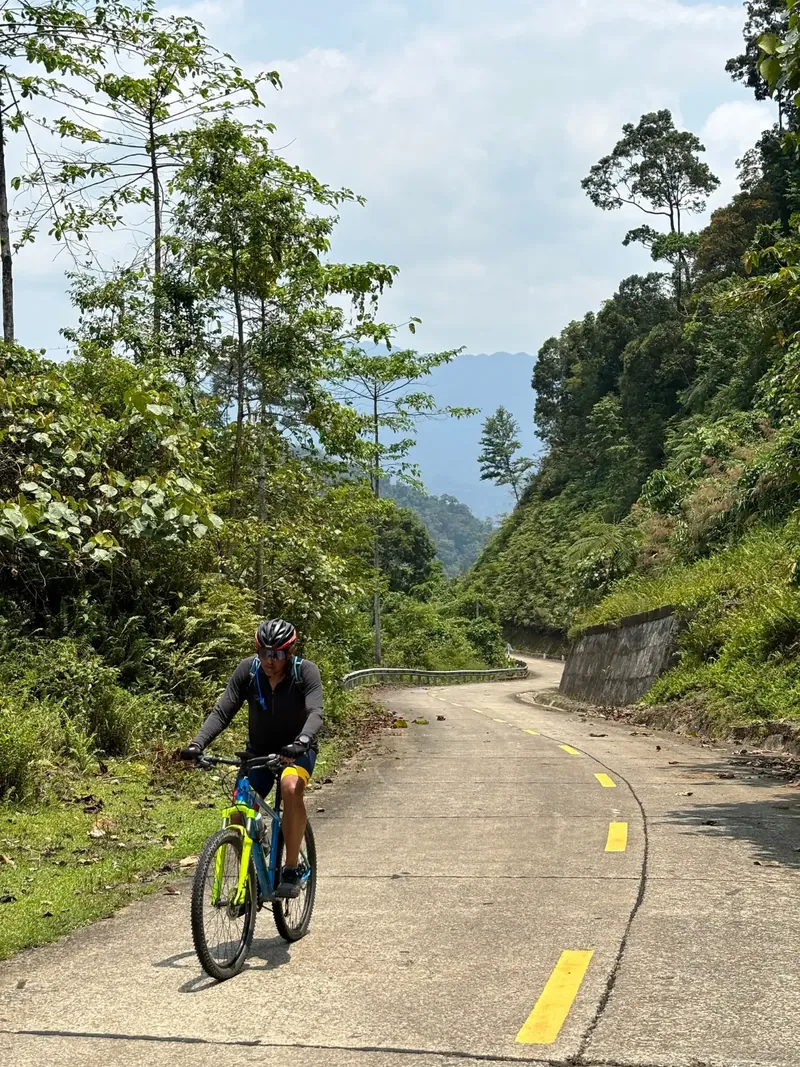
Today’s ride follows sections of the legendary Ho Chi Minh Trail near the Laos border. Dense forests, mountain passes, rivers, and remote villages accompany us throughout the day.
It is worth noting that the original Ho Chi Minh Trail should not be confused with the modern Ho Chi Minh Road. The former was an extensive network of jungle tracks and supply routes used during the Vietnam War, stretching across Vietnam, Laos, and Cambodia. Much of it has now been reclaimed by the forest. The Ho Chi Minh Road, which we also ride later in the day, is a more recent highway network built to connect the length of Vietnam from north to south.
As we ride through the Truong Son Mountains, we pass through the last refuge of one of the world’s rarest mammals, the mythical Sao La, often referred to as the “Asian Unicorn”. Resembling an antelope and only discovered by science in 1992, the Sao La remains one of the great mysteries of the natural world. Along the route, you will notice signs put up by the forest department urging people to protect the last remaining Sao La in Vietnam.
This is one of those rides where you find yourself stopping often, not because you’re tired, but because the scenery keeps demanding attention.
Destination
One of the most unique stays on the tour, this traditional rural Vietnamese guesthouse offers a glimpse into life in one of the country’s most remote regions. The accommodation is simple and dormitory-style, but it’s all part of the experience.
Highlights
- Ride sections of the original Ho Chi Minh Trail
- Spectacular mountain scenery throughout the day
- Spend the night in a traditional house in a hill tribe village
Day 9 From the Mountains to Hue 50 km805 m
- Distance
- 50 km
- Climbing
- 805 m
- Night stay
- Hotel in Hue
- Meals
- Breakfast, Lunch, Dinner
The day
After a short transfer, we begin our final ride, gradually descending towards the Perfume River Valley and the historic city of Hue. The route passes through landscapes filled with fruit trees, spice plantations, and small villages before reaching the elegant tomb of Emperor Minh Mang, one of the finest examples of Nguyen Dynasty architecture.
Having enjoyed the quieter roads of Central Vietnam for the past week, we end our ride here and transfer to our hotel in Hue, avoiding the busy traffic on the outskirts of the city. The evening is yours to celebrate the end of an unforgettable journey through one of Vietnam’s most remote and fascinating regions.
Destination
For nearly 150 years, Hue served as the imperial capital of Vietnam and remains one of the country’s cultural treasures. Set along the banks of the Perfume River, the city is home to magnificent palaces, royal tombs, pagodas, and gardens. Despite suffering extensive damage during the Vietnam War, much of its imperial heritage has been carefully restored. Rich in history, culture, and cuisine, Hue provides a fitting finale to our journey through one of Vietnam’s most remote and beautiful regions.
Highlights
- Descend through the beautiful Perfume River Valley
- Visit Emperor Minh Mang’s elegant royal tomb
- Celebrate the end of the journey in historic Hue
Day 10 Imperial Hue No riding
- Distance
- —
- Climbing
- —
- Night stay
- —
- Meals
- —
The day
For those with some time before their flight, Hue’s Imperial City is well worth a visit. The former seat of the Nguyen Dynasty remains one of Vietnam’s most important cultural and historical landmarks.
Following breakfast, a group transfer will be arranged from Hue to Da Nang International Airport.
Dates & pricing
Booking open
Vietnam Adventure
- Twin sharing
- ₹1,46,000
- Single occupancy
- ₹1,82,000
Every departure runs with a minimum of 8 riders.
The detail
What's included
Included
- 9 nights’ accommodation
- 8 breakfasts, 7 lunches and 8 dinners
- Local guide and Barnowl ride leaders
- Support vehicle, luggage transport, water, snacks & electrolytes
- Group airport pickup and drop-off at Da Nang International Airport
Not included
- International airfare and visa
- Bicycle rental
- Entry ticket to Hue Imperial City
- Lunch and dinner on Day 2
- Travel insurance
- Alcoholic beverages unless specified
Before you come
Practical
information
Fitness & preparation
This is one of Barnowl’s more adventurous tours. The daily distances are manageable, but the combination of climbing, mixed road surfaces, river crossings, and remote terrain means riders should be comfortable spending several hours in the saddle on consecutive days.
Participants should:
Arrive with a well-maintained bicycle that is suitable for mixed surfaces and consecutive days of riding.
Using a GPS navigation device such as a Garmin or Wahoo is mandatory. While a guide will ride with the group, riders are responsible for following the route. GPS files will be shared before departure.
Be comfortable riding on a mix of smooth tarmac, rough pavement, concrete roads, and occasional dirt sections.
Ride with confidence knowing a support vehicle accompanies the group throughout the riding days.
Weather
Late February and early March are among the best times to cycle in Central Vietnam.
Expect daytime temperatures between 22°C and 30°C along the coast, with cooler temperatures in the mountains. Humidity is generally lower than during the summer months, making for pleasant riding conditions.
Conditions can vary considerably between the coast and the mountains, adding to the sense of adventure that defines this tour. The mountains can be noticeably cooler during the mornings and evenings. A light rain jacket, and a wind vest are recommended.
Travel & logistics
Arrival
We will arrange a group pickup from Da Nang International Airport at 11:00 AM on 27 February 2027 . The transfer to Hoi An takes approximately one hour.
We recommend arriving a day earlier if travelling from Europe, North America, or Australia to allow time to recover from the journey and assemble your bike. Hoi An itself is a wonderful town to explore on foot and well worth the extra day.
Departure
The tour concludes in Hue on 8 March 2027. Following breakfast, a group transfer will be arranged to Da Nang International Airport.
Bike rental
A hardtail mountain bike or a gravel bike with 40 mm or wider tyres is recommended for this tour.
For riders not travelling with their own bike, reliable and well-maintained hardtail mountain bikes with disc brakes are available through our local partner in Hoi An. Numbers are limited, and advance reservation is strongly recommended. Rental cost and specifications will be shared closer to the tour date.
Repairs & safety
Basic spares and tools are carried by the guide and on the support vehicle, though we cannot guarantee having spares for every conceivable problem. Carrying a basic tool kit, a spare tube and a pump while riding is recommended.
Wearing a helmet is required on all our biking adventures and is non negotiable. If you do not wear a helmet you will not be allowed to cycle. Your tour leader is trained in first aid and emergency rescue, but to a large degree you must be responsible for your own safety while riding.
More on cycling tours abroad from India, including visas, connections and which month suits where.
Questions
Asked before
you book
If yours isn't here, ask us directly.
Where should I arrive and depart?
The tour begins in Hoi An and ends in Hue. Fly into and out of Da Nang International Airport (DAD), about an hour from Hoi An by road. The group pickup on the first day and the group drop-off on the last are both at Da Nang.
When should I arrive and depart?
Arrive by noon on 27 February 2027 and leave any time after breakfast on 8 March 2027. We meet the group at Da Nang airport on the first morning and transfer to Hoi An, which takes about an hour. After breakfast on the last day we run a group transfer from Hue to Da Nang airport.
If your schedule allows, we strongly recommend spending an extra day or two in Hue . Vietnam’s former Imperial capital is rich in history and culture, with imperial tombs, pagodas, and the Citadel waiting to be explored. Unlike Hoi An, which is geared more towards international visitors, Hue has a distinctly local feel, offering a different side of Vietnam that’s well worth experiencing.
What type of bike is recommended?
A hardtail mountain bike or a gravel bike with 40 mm or wider tyres is recommended for this tour.
Can I rent a bike?
Yes. MTB rentals are available in Hoi An through our local partner. Numbers are limited, so we recommend reserving one well in advance if you require a rental bike. The rental is 3.190.000 vnd ( ~ $120-$130) for the duration of the tour.
Is this a technical gravel tour?
No. The route includes only occasional dirt sections, with much of the riding taking place on quiet rural roads, including Vietnam’s characteristic broken concrete roads. No technical mountain biking experience is required.
How fit do I need to be?
The tour is moderately challenging and is not suitable for absolute beginners. One should be comfortable spending 4-6 hours on the saddle and riding on consecutive days. Some days are longer, but with regular coffee stops, sightseeing breaks, and leisurely lunches, the pace is relaxed and enjoyable.
What is the accommodation like?
While our stays in Hoi An and Hue are in comfortable hotels, several nights are spent in simple but comfortable guesthouses in remote mountain villages where tourism remains minimal. The facilities may be modest, but the access they provide to some of the most beautiful and authentic parts of Vietnam is well worth it.
Can I bring my own bike?
Absolutely. Although renting one locally is also a convenient option.
What will the weather be like?
Late February and early March offer some of the best riding conditions in central Vietnam, with pleasant daytime temperatures and relatively low humidity. While occasional showers are possible, they are usually brief.
Is there vehicle support?
Yes. Two support vehicles accompany the group throughout the tour, a support van and a truck carrying luggage. Between them, they provide luggage transfers, refreshments and mechanical assistance.
Do I have to ride the full distance every day?
We encourage everyone to ride the full distance and experience the tour as it was designed. However, if you’re feeling tired or need a break, you can always hop into one of the support vehicles and rejoin the ride whenever you’re ready.
Can I ride at my own pace?
For the most part, yes. The roads are quiet and traffic is minimal, allowing everyone to settle into their own comfortable pace.
That said, unlike our road tours in Thailand, Sri Lanka, or Europe, this journey involves multiple ferry crossings, remote lunch stops, and logistics that require the group to stay reasonably together.
What kind of terrain can I expect?
Expect a mix of quiet backroads, rural concrete roads, dirt tracks, and sections of the historic Ho Chi Minh Trail. While Days 2 and 3 are mostly flat, the route becomes progressively hillier from Day 4 onwards, with the final three days offering the most climbing.
Do I need permits or special documentation?
No. The route runs within a few kilometres of the Laos border in places, but it never crosses a checkpoint or enters a restricted area, so there are no permits to arrange and no special documentation to carry.
There is one exception, and it is handled for you. The Day 7 hotel sits in an area inhabited by an ethnic minority community, where entry for outside guests is more tightly controlled, and the hotel needs passport details for everyone in the group before you arrive. We collect those and deal with it, so there is nothing for you to do beyond sending the details when we ask.
Can I bring a non-riding companion?
We generally don’t recommend this tour for non-riding companions. Much of the experience revolves around the ride itself, and several nights are spent in simple accommodation in remote locations. In addition, parts of the route involve ferry crossings and private boat transfers that aren’t accessible by support vehicles, making it difficult for non-riders to follow the group. Days are also long, with plenty of time spent exploring waterfalls, enjoying leisurely lunches, and waiting for ferry crossings, so there is limited opportunity for post ride sightseeing.
How large is the group?
Typically 8–12 riders. This tour is best experienced with a smaller group, as we travel through remote regions with limited accommodation, small local eateries, and ferry crossings with restricted capacity. It also allows for a more personal and immersive experience.
What kind of food can I expect?
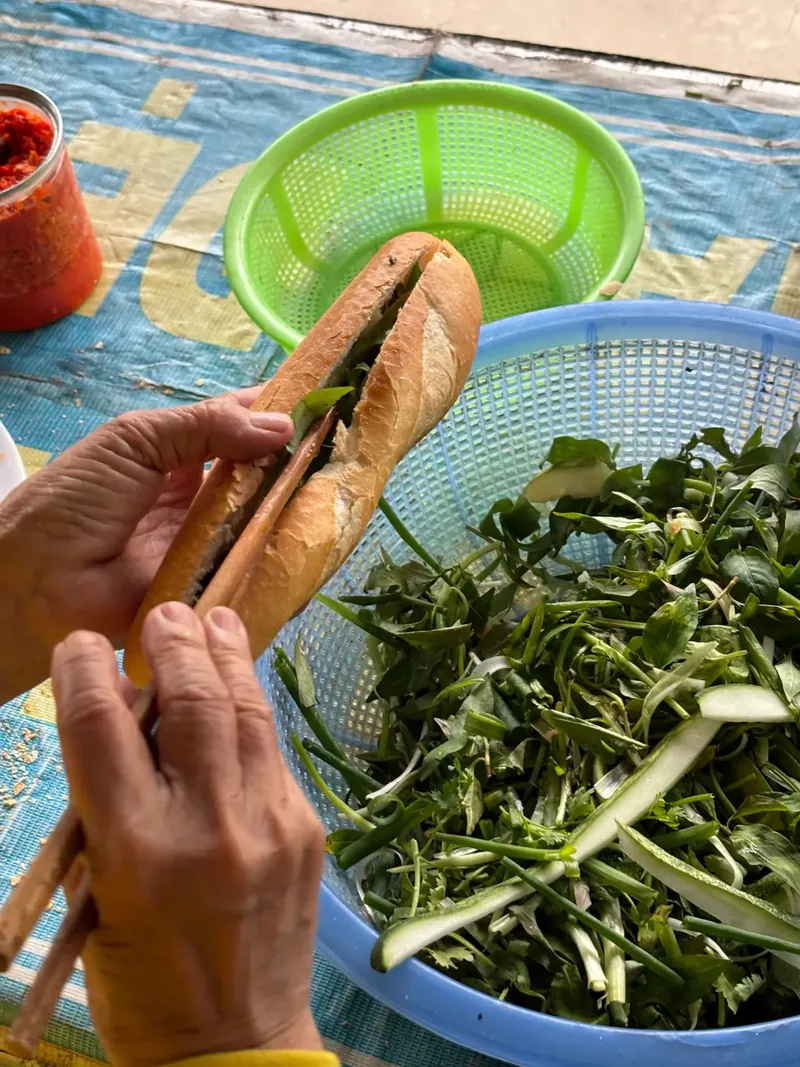
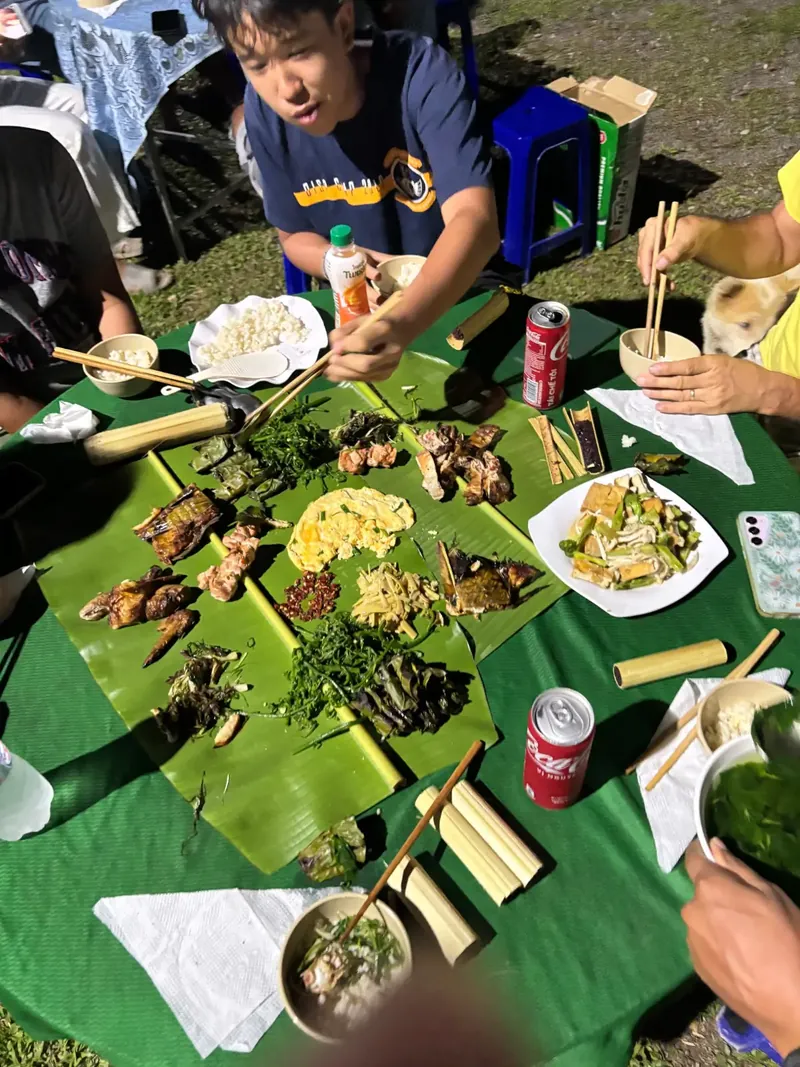
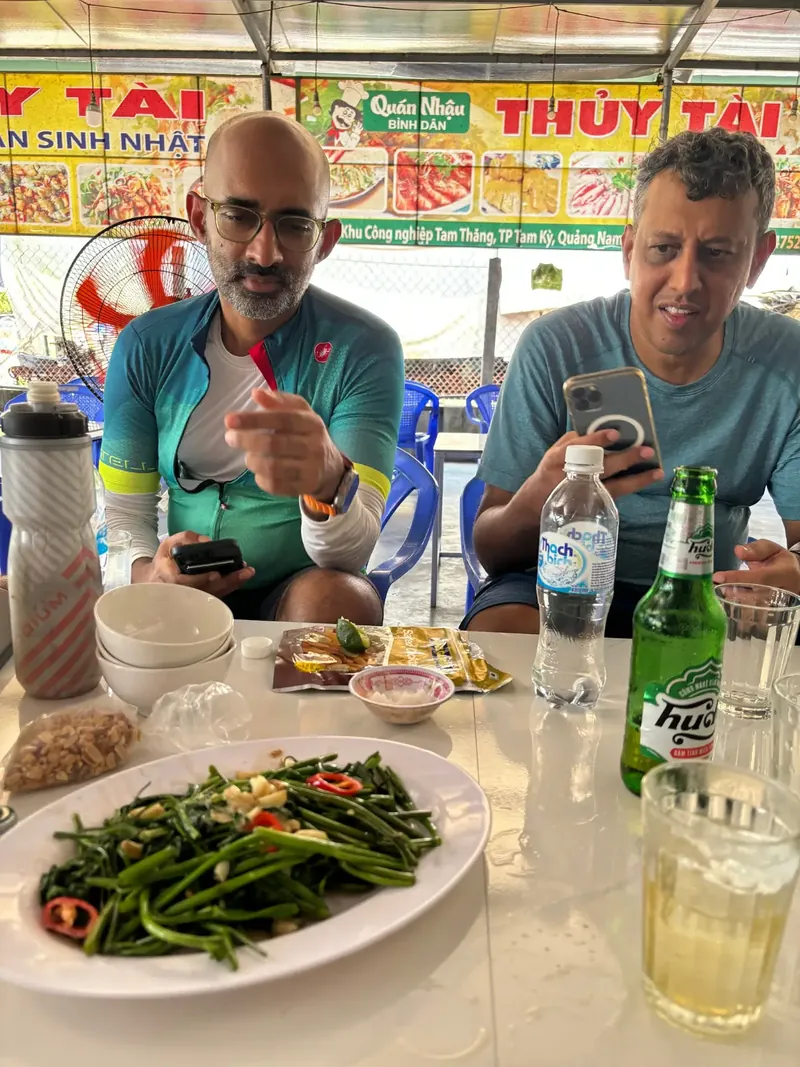
Vietnam is a food lover’s paradise. From steaming bowls of pho and fresh spring rolls to banh mi, seafood, and regional specialities, meals are a highlight of the tour.
Vegetarians should note that options are more limited during the four nights we spend in the remote interior. Rice, vegetables, tofu, and egg dishes are commonly available, and we carry a few staples such as yoghurt and cheese in the support vehicle to supplement meals. With a little preparation, vegetarian riders are generally well looked after throughout the tour.
What meals are included?
Most of them, but not all. The exact count is in the inclusions above, and the itinerary shows which meals fall on which day. Day 2 in Hoi An is deliberately left freer so you can explore the town’s food scene at your own pace.
Riders
Who has ridden
this one
Krish is meticulous with his choice of places, routes and sites en route. The support provided on these tours is fantastic and makes it easy for first-timers to comfortably sign up for multi-day adventures. To top it all, the camaraderie among the riders keeps me coming back for more tours each year.

Read about it
Reading on
this route
Photographs
From the road
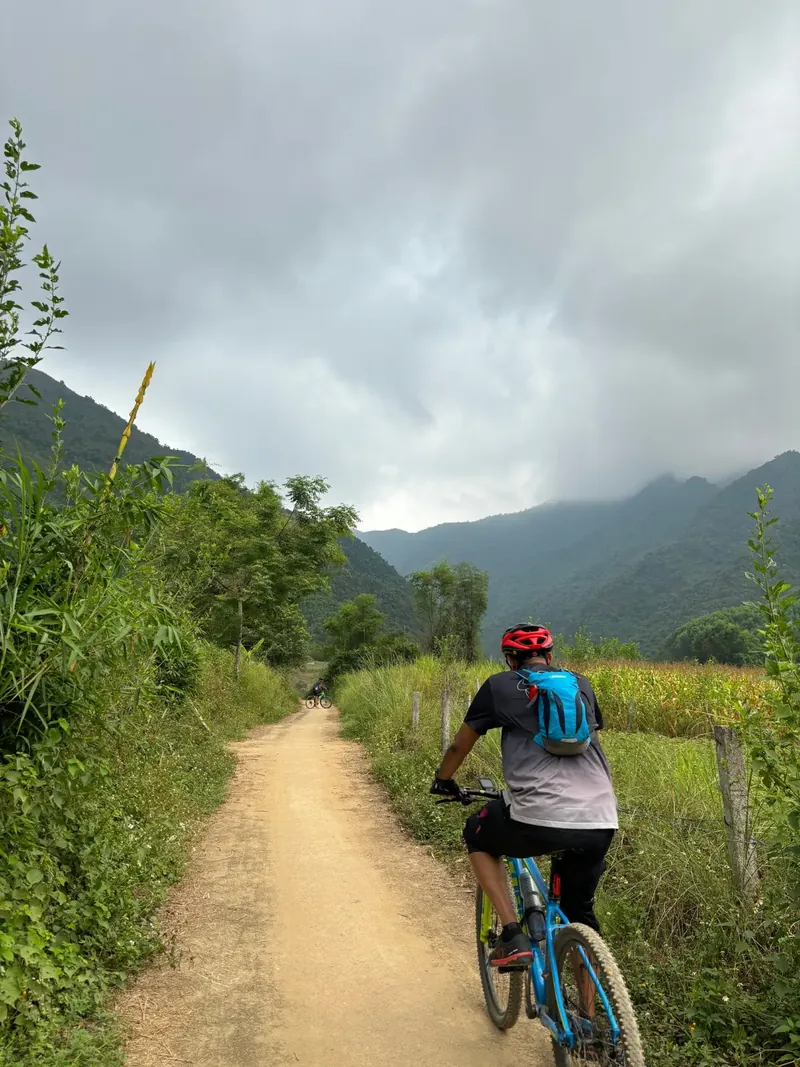
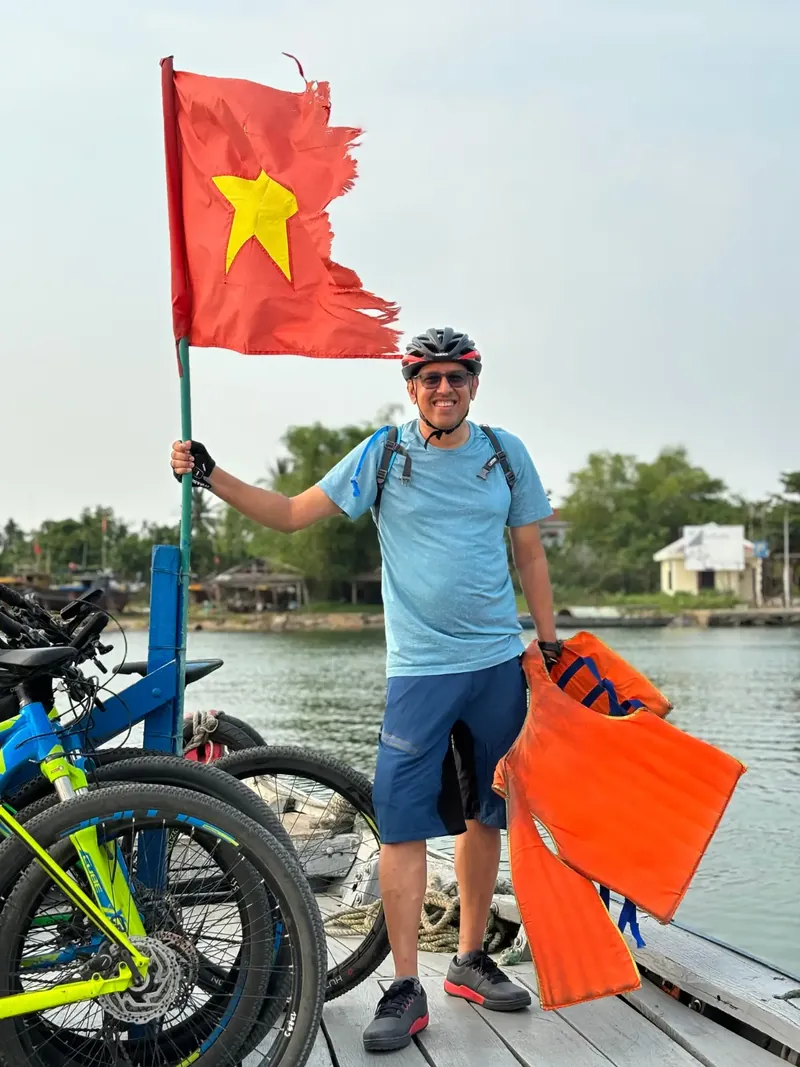
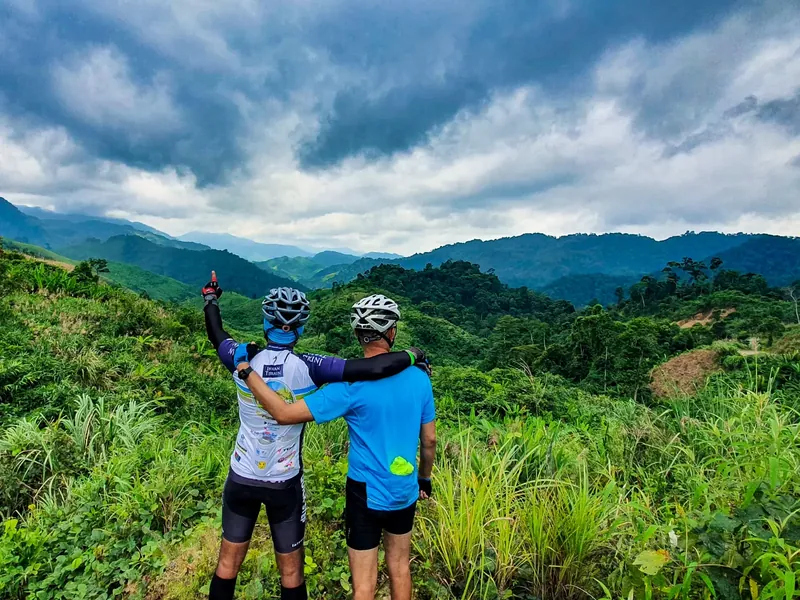
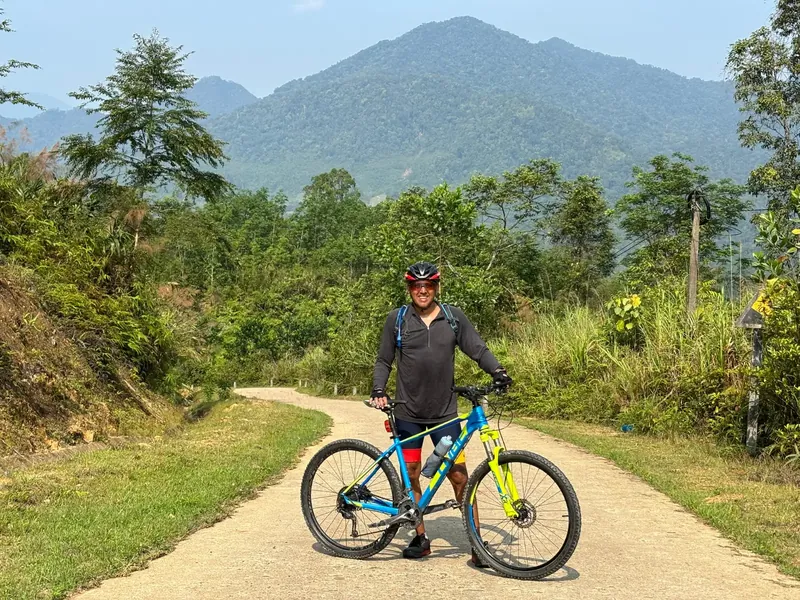
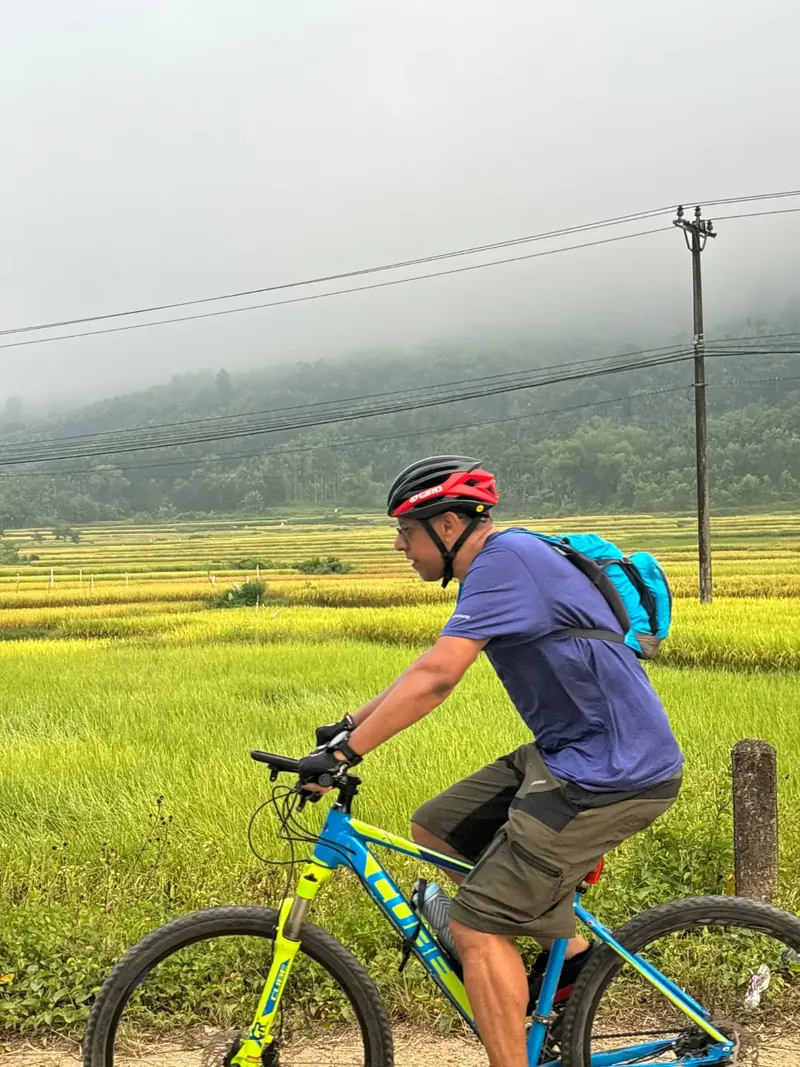
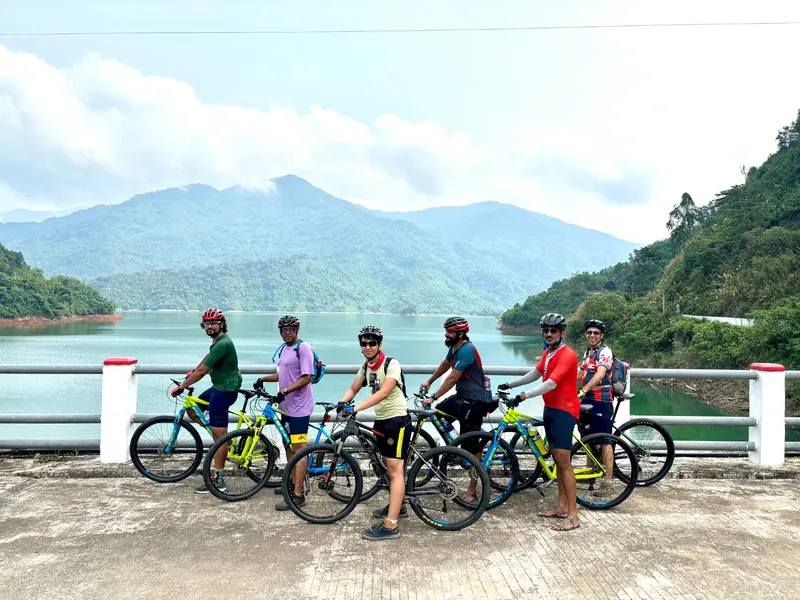
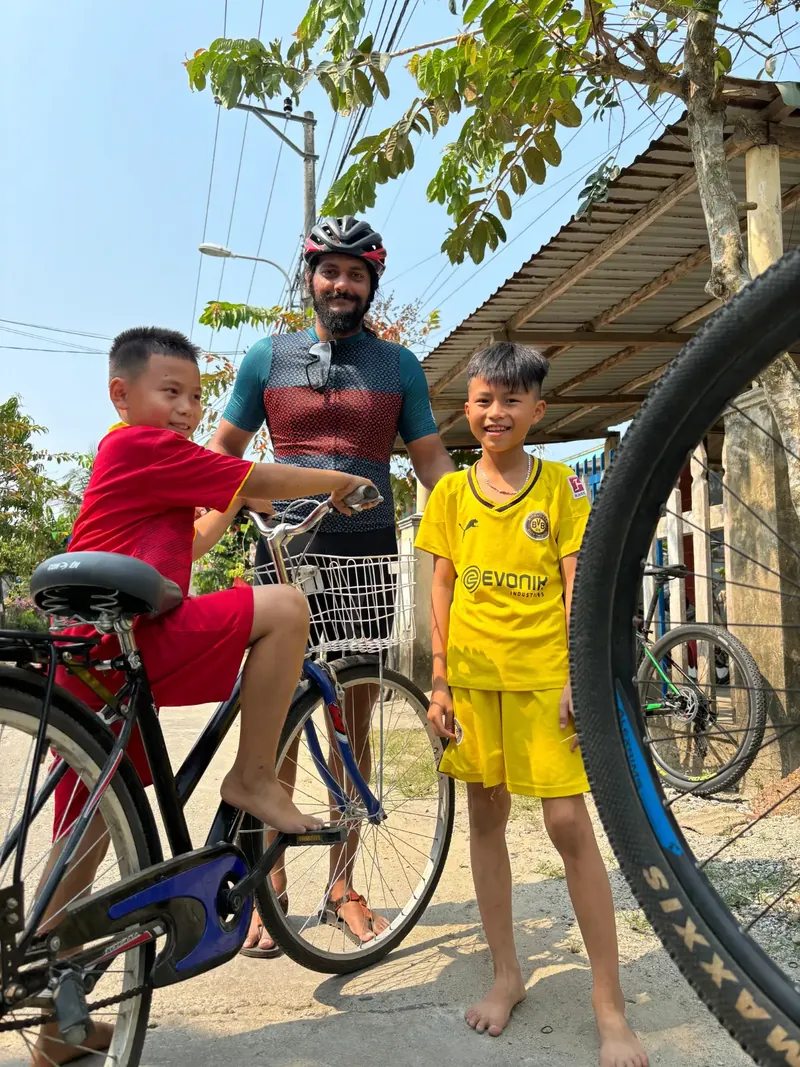
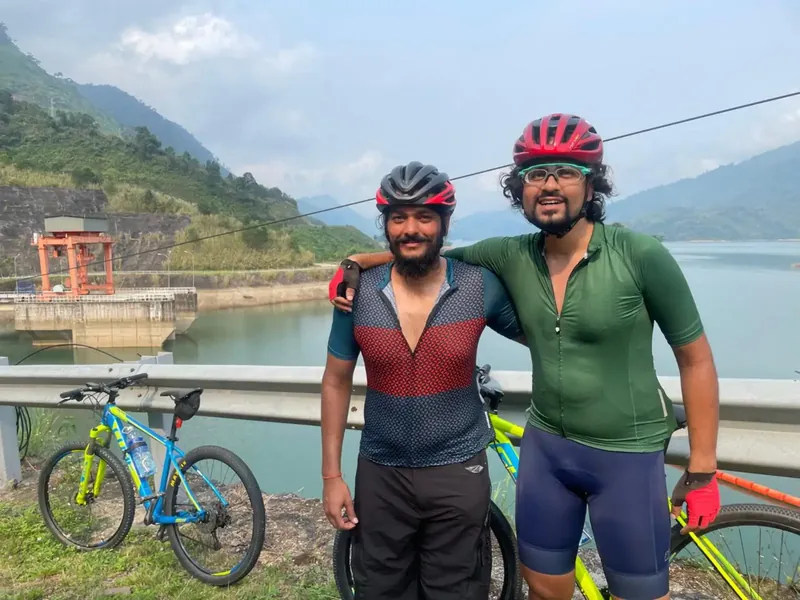
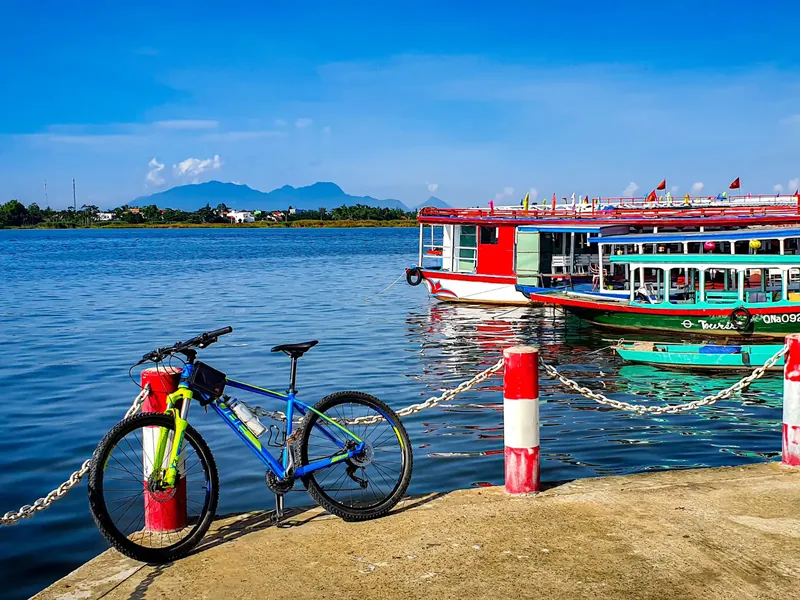
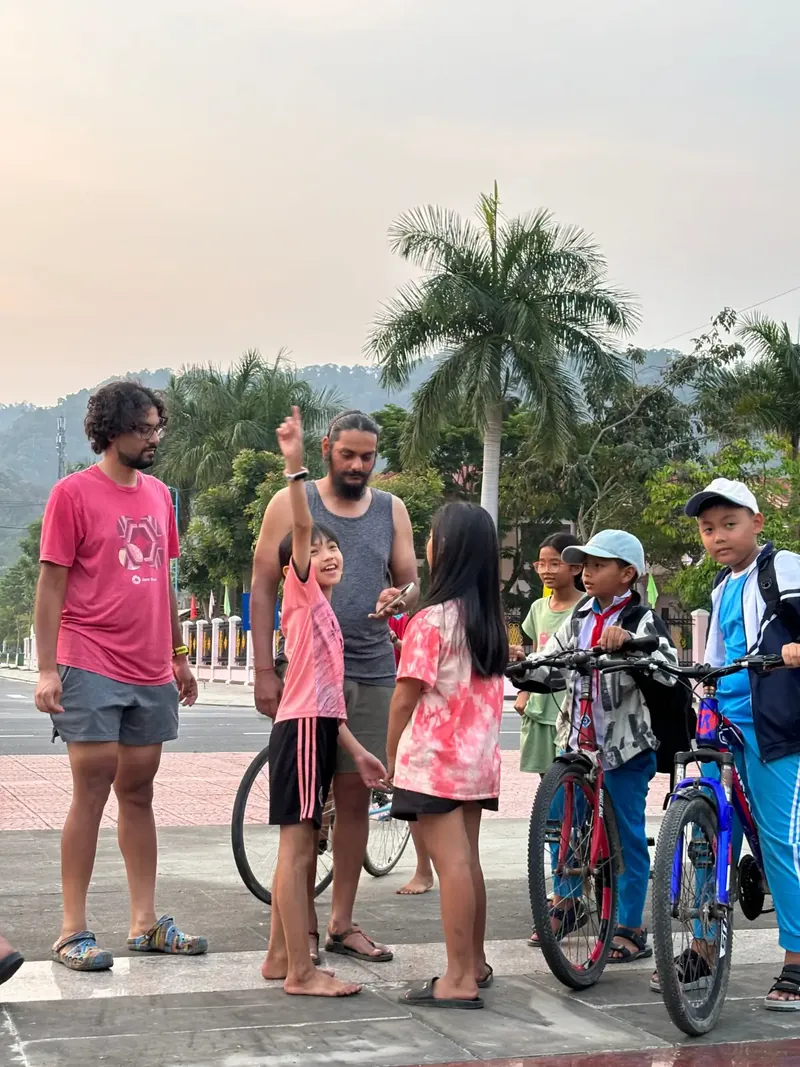
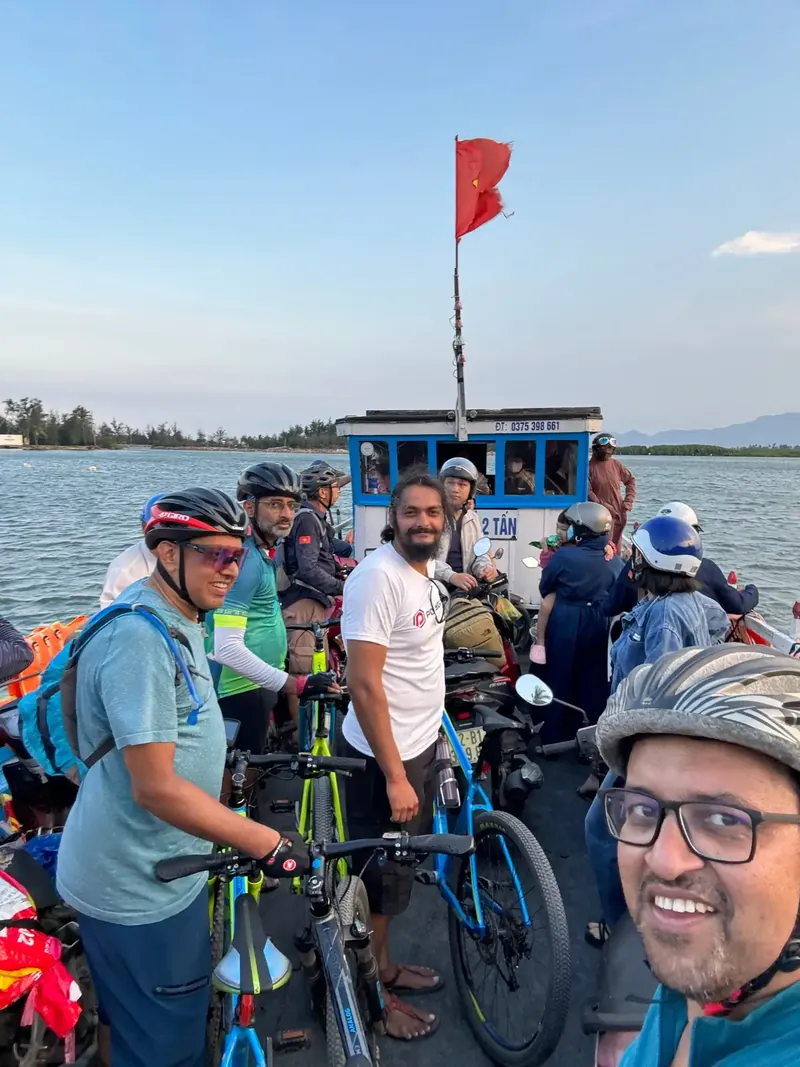
Private groups
Bring your own
group of eight
8 riders or more and we will run Vietnam on your dates rather than ours, with the week built around what your group actually rides.
The week that suits you
Not the departures listed above. Tell us roughly when, and we will work back from the season.
Set to your riders
Daily distance and climbing pitched at the group you are actually bringing, not at an average.
Longer or shorter
The itinerary here runs 10 days. Yours can run longer if you want more of the country, or shorter if the time is what it is.
We scout every route ourselves, so a change to the itinerary is one we plan rather than pass to somebody else. Corporate groups, clubs and friends riding together are all the same job to us.
Also running
Other tours
with dates
Camp Chiang Mai
Train. Suffer. Evolve.
Dec 2026 & Jan 2027Tour of Northern Thailand
Northern Thailand like you have never seen it
More destinations, dates to be announced: Goa, Tuscany, Mae Hong Son, Sri Lanka, Meghalaya, Girona, Mallorca, Portugal.
Difficulty
What the grades mean
Climbing sets the grade, not distance. Measured per riding day, averaged across the tour, with rest days excluded.
Beginner
- Climbing
- Under 500 m
- Distance
- Varies with the terrain
Flatter terrain with fewer challenging inclines. A more relaxed ride, suitable for those not yet accustomed to frequent climbing.
Intermediate
This tour- Climbing
- 500 – 1,200 m
- Distance
- Usually 48 to 88 km
A mix of flat sections, rolling hills and occasional moderate climbs. A more diverse range of landscapes and challenges through the week.
Advanced
- Climbing
- 1,200 m+
- Distance
- Usually 68 to 99 km
For experienced cyclists after a genuinely demanding week. Steep ascents and descents, and a real test of climbing.
On Vietnam Adventure the average riding day is 55 km with 724 m of climbing, across 8 riding days.
Not sure it's for you? Read the full guide or ask us. We will tell you honestly.
Booking
What happens after you pay
We check every payment against the bank ourselves rather than taking a reference on trust.
Your place is confirmed once we have seen it arrive, normally within one working day. You get an email as soon as that is done, and we call you within a day of it to talk through fitness, bike and logistics.
The balance is arranged with you afterwards, on the schedule shown beside the prices. Nothing is taken automatically; every payment is one you make yourself.
Booking
What you pay, and when
Three payments, not one. The deposit holds your place for 72 hours, and the rest is due on the dates below.
- To bookHolds your place
- ₹5,000
- Within 3 daysCompletes the first half
- ₹68,000
- 30 days before departureThe balance
- ₹73,000
Twin sharing, per person: ₹1,46,000 in total, including GST.