Ask a room of serious cyclists where in Spain to spend a week riding and the answer splits almost evenly between two places: the island of Mallorca and the Catalan city of Girona. Both are full of riders every spring. Both have roads that professional teams train on. Both work in April and October.
They are not, though, the same kind of week. We run a camp in each, and the differences are clear enough that most riders should be able to tell which one suits them by the end of this page.
The numbers side by side
| Mallorca | Girona | |
|---|---|---|
| Days | 9 | 8 |
| Riding days | 7 | 6 |
| Distance | 506 km | 434 km |
| Climbing | 7,104 m | 4,761 m |
| Average day | 72 km · 1015 m | 72 km · 794 m |
| Group size | 8–15 | 8–15 |
| Bases | Two: Port de Pollença, then Alaró | One: Girona |
| Fly into | Palma | Barcelona |
| Best months | April, October | April, October |
The daily distance is identical. The difference is the climbing. A Mallorca riding day averages around 28 per cent more climbing than a Girona one, and Mallorca has one more riding day on top. Over the week that adds up to more than 2,300 extra vertical metres.
Mallorca: the mountain week
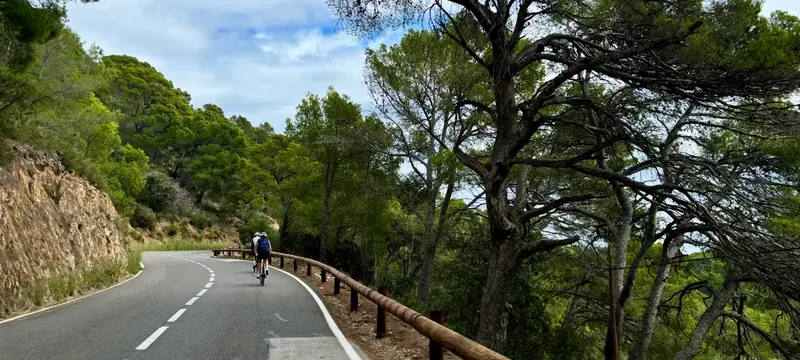
Mallorca's riding is shaped by the Serra de Tramuntana, the range of mountains along the island's north-west coast and a UNESCO World Heritage cultural landscape. Most of the famous roads are in or around it, and they were engineered with real ambition. Two of the best known, the road down to Sa Calobra and the road out along the Formentor peninsula, were designed by the same engineer, Antonio Parietti.
Our week takes in the island's set pieces:
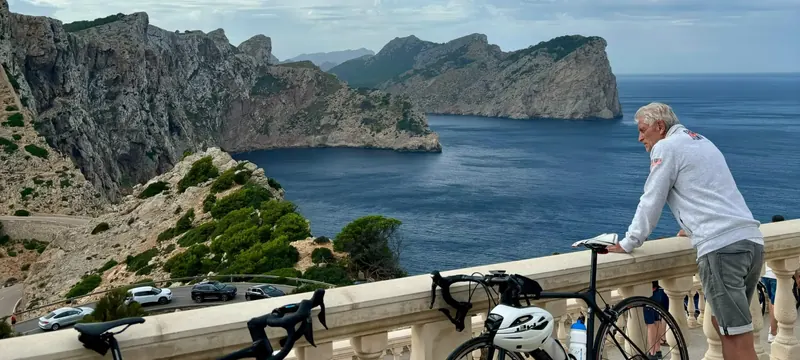
Cap de Formentor: out along the peninsula to the lighthouse at the island's northern tip, 68 km and 1,131 m.
Lluc: the monastery in the heart of the mountains, 75 km and 880 m.
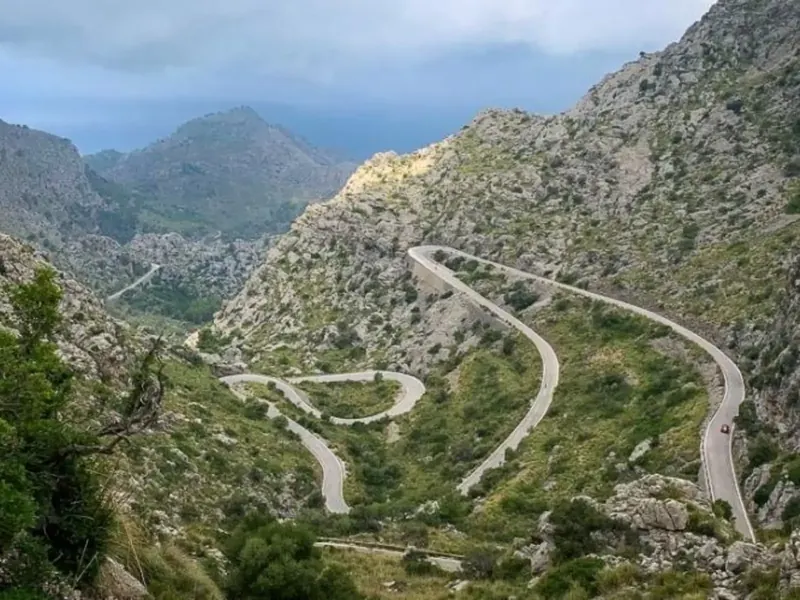
Sa Calobra: the biggest day of the week at 95 km and 2,130 m. The road corkscrews down to a cove and the only way out is back up it. We have written about the climb in detail in our guide to Sa Calobra.
Valldemossa, Deià and the Coll de Sóller: the west-coast villages and the pass above Sóller, 77 km and 1,260 m.
Cura: the monastery on the hill above the island's central plain, 74 km and 810 m.
The rest day falls after Lluc, before Sa Calobra, which is where it is needed.
The character of it: long, well-engineered climbs, big views, and descents that reward confidence. It is the more dramatic of the two weeks and the one with the "I rode that" climbs. It is also the harder one.
The thing to know: you move bases midweek, from Port de Pollença in the north to Alaró in the island's interior. That puts each day's riding closer to its start, but it does mean one packing-up morning.
April is the island's peak cycling season, and the roads are busy with riders. The Mallorca 312 sportive runs in April too, on 24 April in 2027, though its 8,500 places sold out within minutes of opening in October 2026. If you are thinking of combining a camp with an event, that is worth knowing early.
Girona: the rider's town
Girona's appeal is different. It is a small city with a medieval centre that has become one of the most popular bases in the world for professional riders, which says a good deal about the roads around it: varied, quiet, and endlessly re-combinable.
The riding mixes climbs with rolling roads and the coast:
Rocacorba: the climb local riders use as a fitness test, steep and irregular. We have covered it, alongside Els Àngels, in our guide to Girona's climbs.
Els Àngels: the climb straight out of the city that every Girona rider knows.
Sant Grau: the climb and descent to the Costa Brava.
The Costa Brava: coast roads and coffee stops by the sea.
The character of it: shorter climbs and more rolling terrain, with options. From the third day there are longer route options for riders who want more, so a group of mixed ability can ride the same week at different lengths. Coffee stops are built in.
The thing to know: you stay in one hotel all week, which means no packing and no transfers. Bike rental is extra rather than included, so factor it in if you are not bringing your own.
How to choose
Choose Mallorca if you want the bigger mountain week, the famous climbs, and you already climb reasonably well. Over seven riding days, you will average more than a thousand metres of climbing a day. The rest day helps, but this is the harder of the two weeks.
Choose Girona if you want a week you can shape to your form, with options to go longer or keep it shorter, a single base, and a mix of climbs, rolling roads and coast. It is the better week for a group with a spread of abilities, and the better first European cycling trip for most riders.
If you cannot decide, look at what you climbed in your best recent month at home. If a thousand metres a day for a week sounds like a stretch, start with Girona. Our difficulty grades page compares both against everything else we run.
What is the same
The visa. Both are in Spain, so Indian passport holders apply for a Schengen visa through Spain for either. That process has a timeline you need to start early; we set it out week by week in our Schengen visa guide for cycling trips.
The flights. From India, both generally mean a connection through a hub, to Palma for Mallorca or to Barcelona for Girona. If you are bringing your own bike, our guide to flying with your bike from India covers boxes, cases and what airlines charge.
The kit. Both have cold mornings and long descents in April and October. Pack the gilet and arm warmers; our piece on cold descents explains why.
The group. Both camps run for groups of eight to fifteen riders at an intermediate level.
The full itineraries, inclusions and current dates are on the Mallorca Ride Camp and Girona Ride Camp pages.
Written by Barnowl Adventures.