Girona has been home to professional cyclists for the best part of two decades. They come for quiet roads, a mild climate that lets them train through the winter, and a choice of climbs within an hour of the old town that few places in Europe can match.
Two of those climbs define the place, and they could hardly be more different. One is a gentle, wooded road to a hilltop sanctuary that most riders use to warm up. The other is the hill the professionals use to find out how good their legs actually are.
Els Àngels: the one you ride first
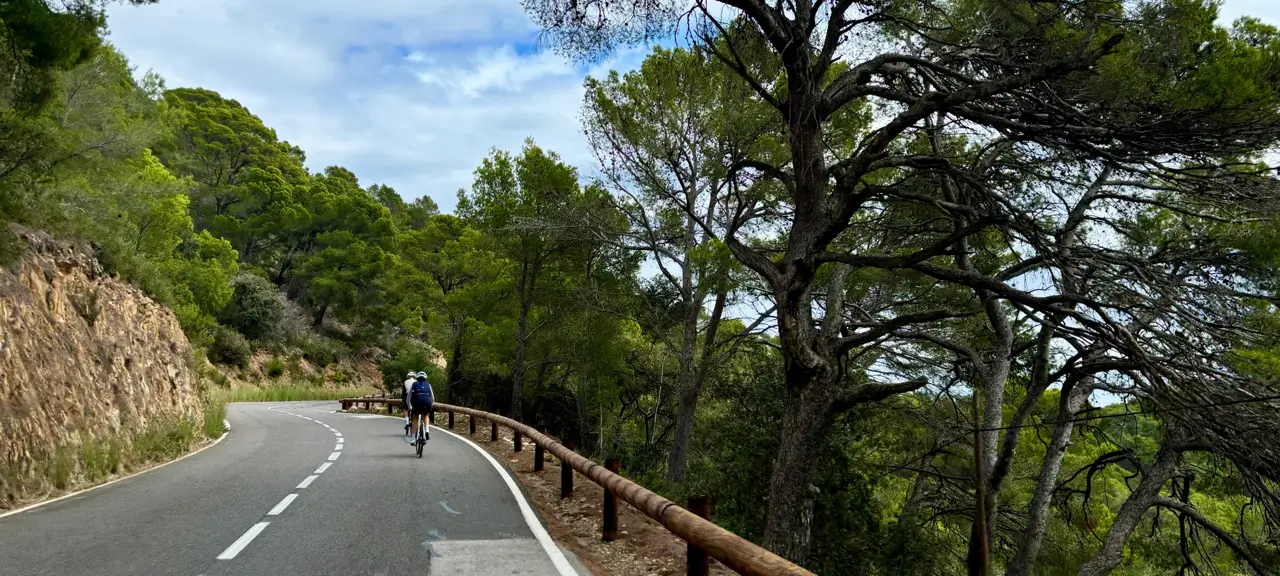
The climb to Els Àngels starts only a few kilometres from Girona, which is a large part of why it gets ridden so often. It runs for roughly ten to eleven kilometres at an average of around three per cent, on a smooth road winding up through woodland. The gradient never really bites. It is the climb you use to open the legs on the first day, to recover on a soft day, or to add to the end of a ride when you want a little more.
At the top is the Santuari dels Àngels, a seventeenth-century sanctuary sitting at over 400 metres in the Gavarres hills. On a clear day the terrace looks across the plain of Girona to the Pyrenees in one direction and out to the Medes islands off the coast in the other. There is a café, which on a Girona ride is close to compulsory.
The sanctuary has one claim to fame that most riders reach the top without knowing. On 8 August 1958, Salvador Dalí married Gala there. It was a deliberately small affair: four priests and the secretary of the municipal court as witnesses, no family, and no photographs. A few years later Dalí bought Gala a castle at Púbol, not far from the sanctuary, chosen partly because of where they had married.
Els Àngels is also the hill climb within the annual Girona Gran Fondo, so if it feels easy on a Tuesday, it is worth remembering that some people race it.
Rocacorba: the one that tells you the truth
About twenty kilometres north of Girona, outside the town of Banyoles and its lake, is the mountain of Puigsou. Cyclists know the road up it as Rocacorba, after the twelfth-century Santuari de Rocacorba that sits just short of the summit.
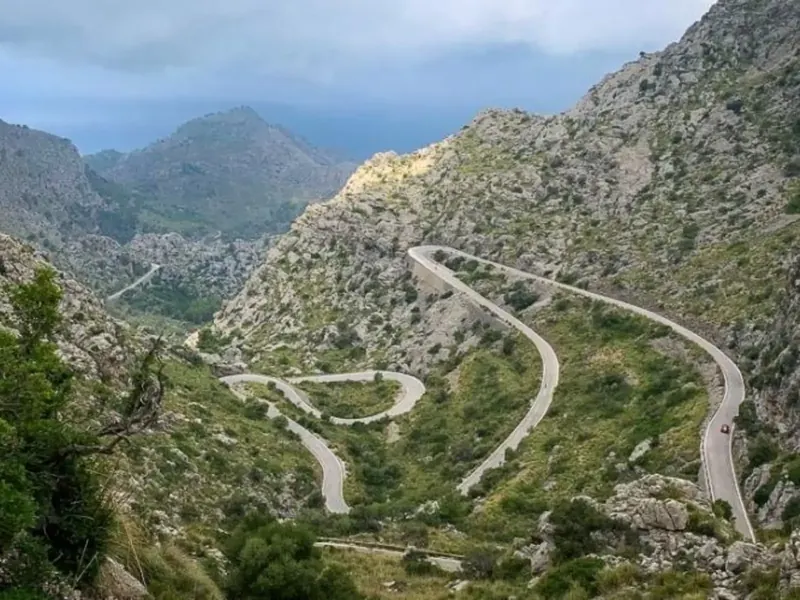
Ask three sources how long Rocacorba is and you will get three answers, because it depends on where you start the clock. Measured from the stone bridge over the Matamors river, it is roughly ten kilometres at about seven per cent. Taken from Banyoles, it runs closer to fourteen kilometres at an average nearer six and a half, topping out at around 970 metres. Either way, the average is the least useful number. The gradient is irregular, easier at the bottom and then a series of ramps that reach fifteen per cent, and it rides harder than its figures suggest.
What makes Rocacorba matter is who rides it and why. The road was only paved in 2006, carries very little traffic, and has a single way up and down. That makes it a clean test, and Girona's professionals have used it for exactly that: a time up Rocacorba is how a lot of riders in the town find out where their form is before a season. David Millar, who lived in Girona, named his cycling club after it.
Locals have a rule of thumb for a respectable time: your age plus ten minutes. It is meant as a joke and works surprisingly well as a benchmark.
Two practical notes. The surface is not one to trust in the wet, so it is a climb for a dry day. And there is no descent to escape onto partway. Once you commit, the only way down is the way you came up.
How they fit into a week in Girona
Most riders who come to Girona for a week will meet both. On our own Girona camp, Day 6 is built around Banyoles and Rocacorba, with a 78 km standard route and a 102 km long option that climbs 1,695 metres. Across the week there are around 4,761 metres of climbing on the standard routes, averaging 72 km and 794 metres a riding day, with a longer option on most days from Day 3 onwards for riders who want more.
Els Àngels comes on Day 3 and Rocacorba on Day 6, and the order is the point. Els Àngels is the road you ride when you want to feel good. Rocacorba is the one you save for when you want to know.
When to go
Girona is ridden best in spring and autumn. Our own camp runs in April and October, when the days are warm enough to ride comfortably and cool enough to climb hard. Summer is hot inland, and the climbs feel it.
The full itinerary for our Girona camp, including Rocacorba, Sant Grau and the Costa Brava, is on the Girona Cycling Camp page. Dates are not on sale yet. If you want to hear when they are, leave your name on that page and you will hear first.
Written by Barnowl Adventures.