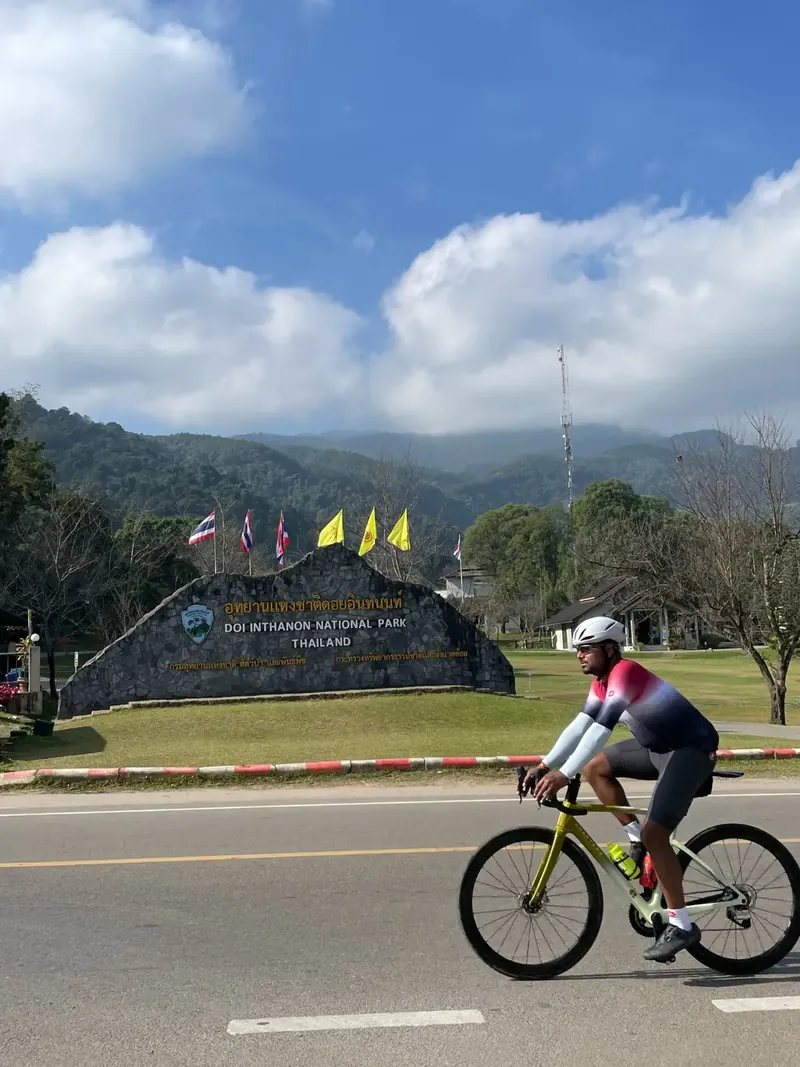
Doi Inthanon is the highest point in Thailand, and the road to its summit is the biggest single climb in Southeast Asia that most riders will ever do. From the valley floor it is well over two thousand vertical metres of uninterrupted climbing, ending in cloud forest at a temperature most Indian riders have never cycled in.
It is also a climb with rules attached that the route guides rarely mention, and one of them changes how you plan the whole day.
The mountain is named after King Inthawichayanon, the seventh ruler of Chiang Mai, who reigned from 1870 to 1897 and asked for his remains to be kept on its summit.
Three ways up
There are three paved routes to the top. All three finish on the same final stretch of road.
From Chom Thong, Route 1009: the classic. This is the side most riders mean when they talk about climbing Doi Inthanon, and the route of the annual Doi Inthanon Challenge, a 47 km uphill race. Depending on where you start counting, it is roughly 39 to 47 km long with around 2,200 to 2,300 metres of climbing. The average works out at about 6 per cent from the most common start point, but the average hides a lot: the steepest pitches pass 17 per cent.
From Mae Chaem, Route 1192: the steep one. Shorter, at around 30 km, and harder, averaging about 7.3 per cent for more than 2,100 metres of climbing. Its steepest hundred metres are reported at over 17 per cent. If you want the toughest version of the mountain, this is it.
From Mae Wang: the long way round. The quietest and the longest, at about 57 km and around 2,800 metres of climbing. The average is under 5 per cent, which makes it sound easy. It is not: there are ramps above 13 per cent, and one rider recorded 21 per cent on a short section.
What the climb is actually like
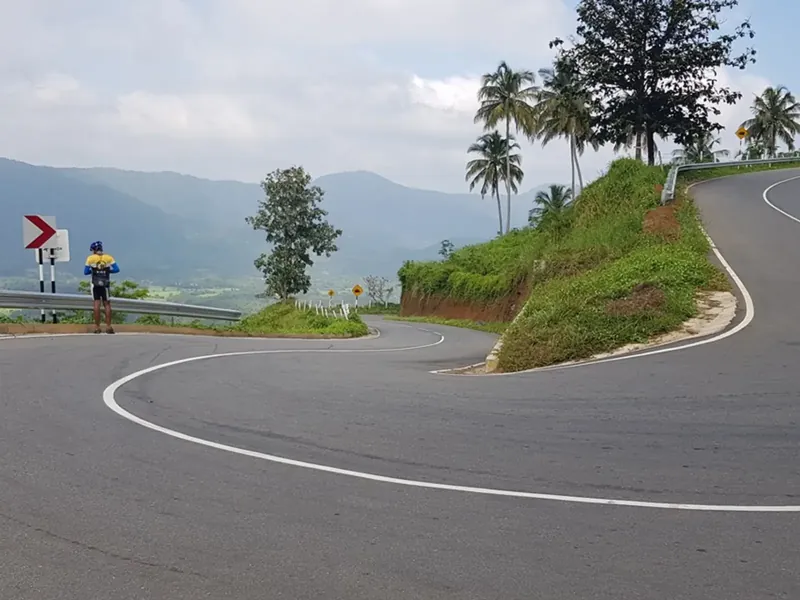
Doi Inthanon is not a steady Alpine gradient. The road climbs in steps, with short downhills and flatter sections between steep pitches, so the average figures tell you less than they would on a European climb. Expect to be out of the saddle on the steep ramps, then spinning on the easier stretches between them.
The scenery changes as you climb. Farmland and dry forest at the bottom give way to thicker forest, and near the top to cloud forest, damp and mossy and noticeably colder. Shortly before the summit the road passes the twin royal pagodas, which are worth a stop if your legs allow it.
How long it takes depends almost entirely on the rider. As a rough guide to the Chom Thong side: at an average of 11 km/h you are looking at about three and a half hours of climbing; at 7 km/h, more than five. Plan your water, food and clothing around the slower of those two numbers rather than the faster.
The rule that changes everything: you can't ride down
Downhill cycling is banned on Doi Inthanon. The national park prohibits riding bicycles down the mountain on Route 1009, Route 1192 and Road 4016 between Khun Klang and Khun Wang. The reason given is safety: the descents are long and steep, the road surface is often damp and slippery under the forest canopy, and there have been serious accidents.
The ban was reported in Thai media in 2022 and again in 2024. The 2024 reporting added further conditions for cyclists going up: riders must not ride alone, and a support vehicle must follow them. Penalties for breaking the rules were mentioned but not specified.
In practice this means:
You climb on the bike and come down in a vehicle. Plan the day as a one-way ride. If you are riding independently, you need a car or pickup waiting at the top, or arranged to follow you.
Do not plan to ride alone. Even if you are a confident solo rider, the park rules expect a group and a following vehicle.
Check the current rules before you go. Park regulations change. Contact Doi Inthanon National Park or ask a local operator what applies in the season you are riding. We checked the rules described here on 6 November 2026.
It is worth saying that this rule is not a bad thing. The descent from Doi Inthanon is long, cold and technical, on wet tarmac, with traffic coming up. Being driven down is a perfectly sensible way to end a two-thousand-metre climb.
How cold it is at the top
In December and January, the summit regularly records around 3°C at dawn, and frost on the grass is not unusual. On the same morning Chiang Mai might be 16°C. That difference catches out riders who have packed only for the warmth of the valley.
You will be climbing slowly, sweating, and arriving at the top damp. Then you will be standing around in cloud at a few degrees above freezing. Even though you will not be descending on the bike, the ride down in a vehicle will be cold if you are still in a wet jersey. Pack a windproof layer, arm warmers, thin gloves and a dry base layer to change into at the summit. Our piece on cold descents has the full list.
Gearing and fuelling
Gearing. For most riders, a compact chainset (50/34) with a 34-tooth or larger cassette sprocket is the sensible minimum here, particularly on the Mae Chaem side and on the steep ramps of all three. The extra low gear is worth more than any weight you save leaving it off. We have worked through the numbers in our guide to gearing for a mountain cycling holiday.
Fuelling. A three- to five-hour climb needs eating from the start, not from the point you start to feel empty. Carry more than you think you will need, and drink more than you think you need in the warmer lower slopes. There is more on this in our piece on fuelling and recovery for back-to-back riding days.
When to go
The cool, dry season from November to February is the time to ride Doi Inthanon. The air is clearer, the lower slopes are bearable, and the summit is cold rather than wet. Outside those months you trade cool mornings for heat lower down and rain higher up.
One practical note: when the Doi Inthanon Challenge race runs, parts of the road are closed to other traffic for the event. If you are riding independently, check the race date before you plan your day.
Riding it with us
Doi Inthanon is one of the highlights of our Mae Hong Son Loop, which we run in the cool season. The tour is fully supported, with a vehicle with the group throughout, which is exactly what the park rules call for, and the national park entry fee is included.
If you want to know what the rest of that week involves (693 km and more than 15,000 metres of climbing), read our piece on the Mae Hong Son Loop by bike. If you would rather start with something gentler around Chiang Mai, our Chiang Mai in November post covers the Samoeng loop and Doi Suthep. The full itinerary for the loop is on the tour page.
Written by Barnowl Adventures.