The cheapest upgrade most riders can make before a week in the mountains is not fitness. It is gearing.
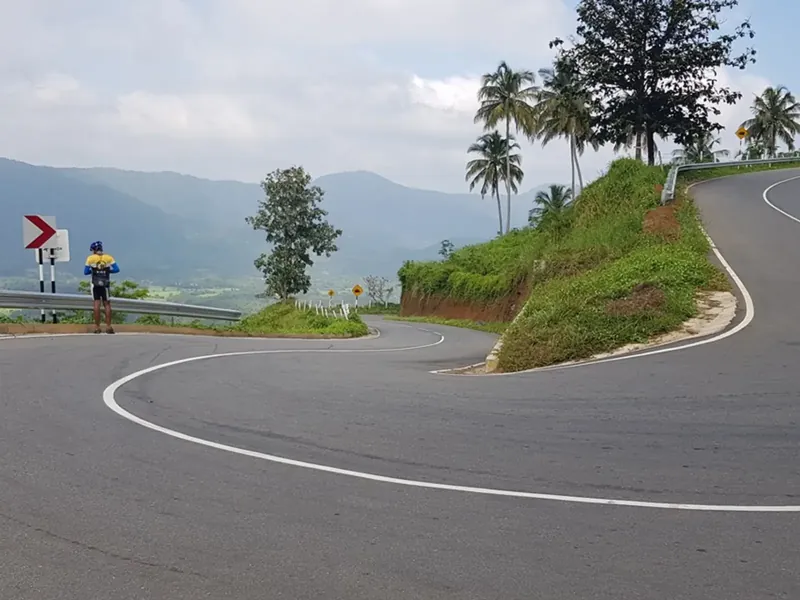
A bike set up for the flat roads most Indian riders train on is often geared too tall for sustained climbing. On the flat, that never shows. On a nine-kilometre climb at seven per cent, on the third day in a row, it is the difference between spinning and grinding, and grinding is what wrecks legs over a week.
Why cadence matters more on a tour than on a single ride
On a one-off climb you can push a big gear and recover tomorrow. A tour does not give you tomorrow. Riding at low cadence loads the muscles harder for every pedal stroke, and that fatigue accumulates from one day to the next. Most riders climb most comfortably somewhere in the 70s or 80s rpm. Below about 65 rpm on a long climb you are grinding: fine for a short ramp, expensive over forty minutes.
The goal of gearing is simple: let you hold a sustainable cadence at the power you can hold, on the gradients you will actually ride.
What different gears actually give you
We calculated the cadence a rider would turn on common gear combinations at different gradients. The assumptions are stated below the tables; the shape of the result holds across a wide range of riders.
At 180 watts, about 2.6 W/kg for a 70 kg rider:
| Gradient | Speed, km/h | 39×28 | 36×30 | 34×28 | 34×32 | 34×34 | 34×36 |
|---|---|---|---|---|---|---|---|
| 5% | 13.7 | 78 | 90 | 89 | 102 | 108 | 115 |
| 7% | 10.5 | 60 | 69 | 68 | 78 | 83 | 88 |
| 10% | 7.7 | 44 | 51 | 50 | 57 | 61 | 64 |
At 220 watts, about 3.1 W/kg:
| Gradient | Speed, km/h | 39×28 | 36×30 | 34×28 | 34×32 | 34×34 | 34×36 |
|---|---|---|---|---|---|---|---|
| 5% | 16.3 | 92 | 107 | 106 | 121 | 128 | 136 |
| 7% | 12.7 | 72 | 83 | 82 | 94 | 100 | 106 |
| 10% | 9.3 | 53 | 62 | 61 | 70 | 74 | 78 |
Figures are cadence in rpm. Assumptions: rider 70 kg plus 9 kg of bike and kit, rolling resistance 0.005, CdA 0.40, air density 1.2 kg/m³, 97.5% drivetrain efficiency, 2.11 m wheel circumference.
What the numbers say
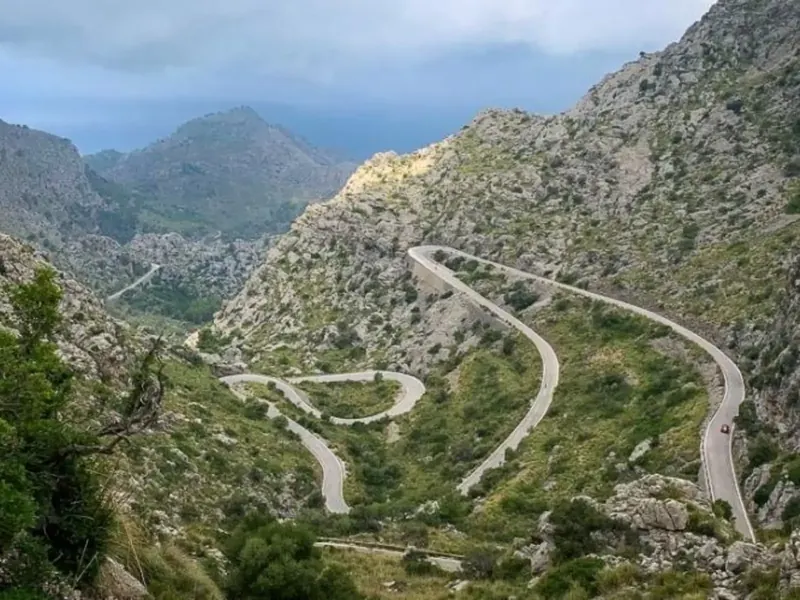
On a 7% climb, a standard 39×28 is a grind for most riders. At 2.6 W/kg it gives 60 rpm. Seven per cent is the average gradient of Sa Calobra in Mallorca, and of Rocacorba in Girona measured from its usual start: climbs that take forty minutes or more. The same rider in a 34×34 turns 83 rpm.
At 10%, almost everyone needs a 34 or bigger at the back. Even at 3.1 W/kg, a 34×28 gives only 61 rpm. A 34×34 gives 74.
On very steep ramps, nobody spins. At 15 per cent, every combination sits below 65 rpm unless a very strong rider is in one of the lowest gears. That is fine. Short steep pitches are ridden out of the saddle or ground through. Gearing is for the sustained climbs, not the walls.
A semi-compact 36×30 behaves almost exactly like a 34×28. If you already run 52/36, a 30 or 32 sprocket at the back gets you most of the way there.
What we recommend
For a week of sustained climbing (the Mae Hong Son Loop, Mallorca, Girona, our Chiang Mai camp), a compact chainset (50/34) with a 34 or 36 sprocket at the back is a sensible choice for most riders. It is what we recommend on that camp, where the riding averages over 1,200 metres of climbing a day.
For flatter tours with occasional climbs, such as Northern Thailand at around 540 metres a day, a 34×30 or 34×32 is usually enough.
On gravel and mixed-surface routes, the same logic applies to 1x setups. A 40-tooth chainring with a 44-tooth sprocket is a slightly lower gear than 34×36, which is why wide-range gravel drivetrains climb well.
Before you change anything
A bigger cassette is not always a straight swap. Your rear derailleur has a maximum sprocket size and a capacity it can handle, and a larger cassette may need a longer chain or a different derailleur. Have a mechanic check compatibility before you buy, and do it weeks before you travel, not the day before you pack the bike.
Then ride the new gearing at home. A few rides are enough to get used to it, and to make sure everything shifts cleanly under load.
The short version
If your bike has a 39 or 36 at the front and a 28 at the back, and you are heading for a week of real climbing, change your gearing before you change anything else. It will do more for your week than any amount of last-minute training.
For how much climbing each of our tours involves per day, see our difficulty grades. And for building the legs to go with the gears, see our guide to training for climbing when your local roads are flat.
Written by Barnowl Adventures.