Every rider planning a cycling trip abroad reaches the same question within about ten minutes: do I take my own bike?
There is no single right answer, but there is a right way to decide, and a set of checks that will spare you an argument at the check-in counter. This is what we tell riders before they book a flight.
First, decide whether to fly it at all
Take your own bike when the fit matters to you more than the hassle: your position, your saddle, your gearing, the bike your body already knows. On a hard week of riding, a familiar bike is worth a great deal. It also makes sense when the riding at the other end calls for something specific that you already own.
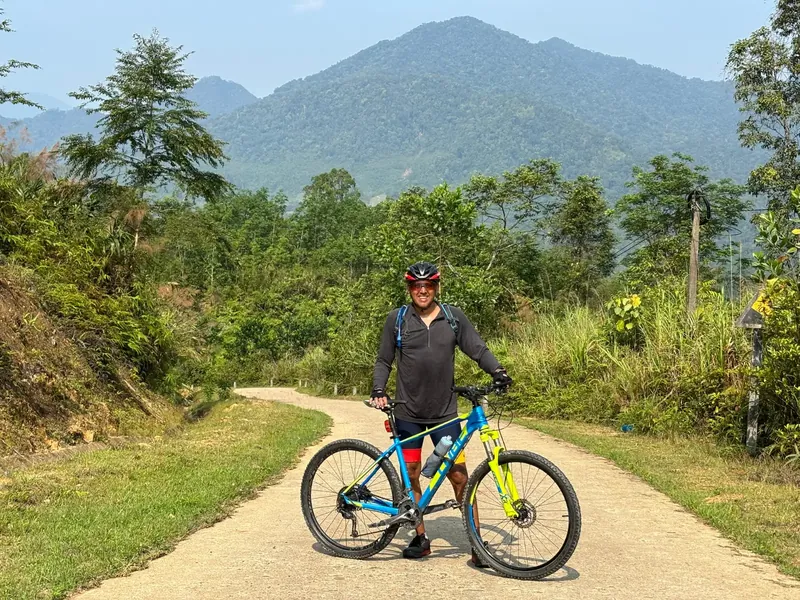
Rent at the other end when the terrain asks for a different bike from the one you have, or when the trip involves several flights. Our Vietnam tour, for instance, rides dirt, concrete and tarmac, and wants a hardtail mountain bike or a gravel bike with tyres 40 mm or wider. Most riders' road bikes would be the wrong tool, and hardtails can be rented through our local partner in Hoi An. Our Girona camp offers rental at an additional cost for riders who would rather not travel with a bike.
A useful rule: the more connections in your journey, the stronger the case for renting. Every extra leg is another chance for a bike to be delayed, mishandled, or arrive after you do.
Box, hard case or soft bag
A cardboard bike box, usually free from a bike shop, is the cheapest option and better than people expect. It is light, and handlers tend to treat a large box as a large box. It does not survive repeated use well, and you need somewhere to dispose of it or store it at the other end.
A hard case gives the most protection and lasts for years. It is also the heaviest option, which matters when your bike's weight counts against your baggage allowance. More on that below.
A soft bag with internal padding is lighter and easier to store, but relies more on how well you pack it.
Whichever you use, the same things go wrong: rear derailleurs and hangers get bent, disc rotors get knocked, and frames get scuffed where they touch each other. Remove the pedals, take off or protect the rear derailleur, pad the frame tubes, remove the rotors or protect them, and put a spacer between the brake pads if you have hydraulic discs. Photograph the bike before you pack it, so you have evidence if you need to make a claim.
The airline checks that matter
Rules differ by airline and change without much notice, so treat this as a list of what to check rather than an answer. Always read your carrier's own page, not a third-party summary. The summaries are often years out of date and contradict each other.
Airline details checked on 1 October 2026. Confirm with your airline before you fly.
1. Does the airline need advance notice? Many do. IndiGo, for example, asks to be notified at least 48 hours before the flight if you are carrying a bicycle as checked baggage. Turning up without having done so is the commonest cause of trouble.
2. Is there a sports equipment fee, and is it cheaper to pay in advance? Most carriers charge a handling fee for a bicycle, per bike, per journey. IndiGo's own page lists ₹3,500 for pre-booking sports equipment on an international sector, with a higher figure if you leave it to the airport. Paying online in advance is usually cheaper and removes a conversation at check-in.
3. Does the bike's weight count towards your allowance? Usually, yes. On IndiGo the sports equipment fee is charged on top of any excess baggage charges, and the bike's weight counts towards your free allowance. A bike in a hard case can easily take up most of a standard allowance on its own, so check what you are left with for everything else.
4. Is there a size limit? Many airlines treat items over 158 cm in combined length, width and height as special or oversized baggage. Almost every boxed bicycle exceeds that, so assume yours counts as special baggage and plan accordingly.
5. What happens at the connection? If your journey involves two airlines on separate tickets, you may pay two sets of fees and have to collect and recheck the bike in between. A single ticket, ideally on one airline or within one alliance, makes the bike far more likely to arrive when you do.
How many connections, by destination
This is where the choice of tour starts to matter. Northern Thailand is the easiest of our destinations to reach with a bike: Bangkok is a direct flight from several Indian cities, and the tour starts one domestic flight on from there, in Chiang Rai. Destinations such as Da Nang for Vietnam, or Barcelona for our Girona camp, generally mean at least one connection from India before you land, and each one is a reason to think harder about renting.
Two small things people forget
Check your travel insurance. Many policies limit cover for sports equipment, or exclude damage in transit entirely. Find out before you fly, not after.
Pack the tools you need to rebuild the bike. The pedal spanner, the hex keys for your stem and bars, and a pump if you are not certain one will be available. On our tours there is mechanical support, but you still want to be able to build up and check your own bike on arrival.
Before you book
The questions above are the same whichever tour you are flying to. Which month suits which destination, which Indian cities connect most easily, and what we provide at the other end are covered on our page for riders flying out of India.
Written by Barnowl Adventures.