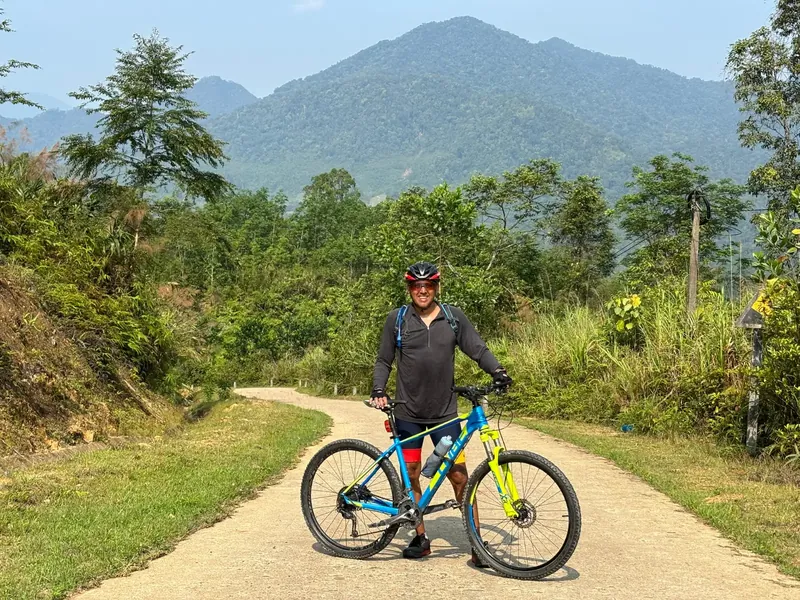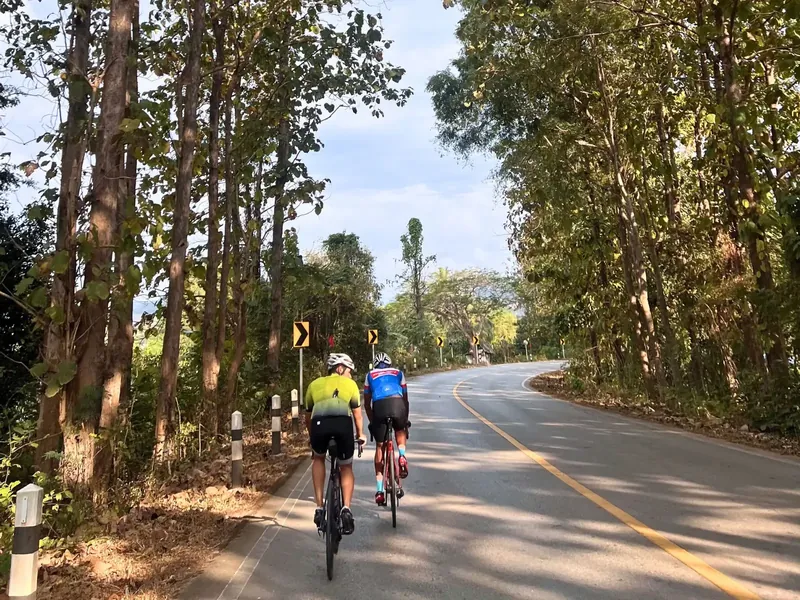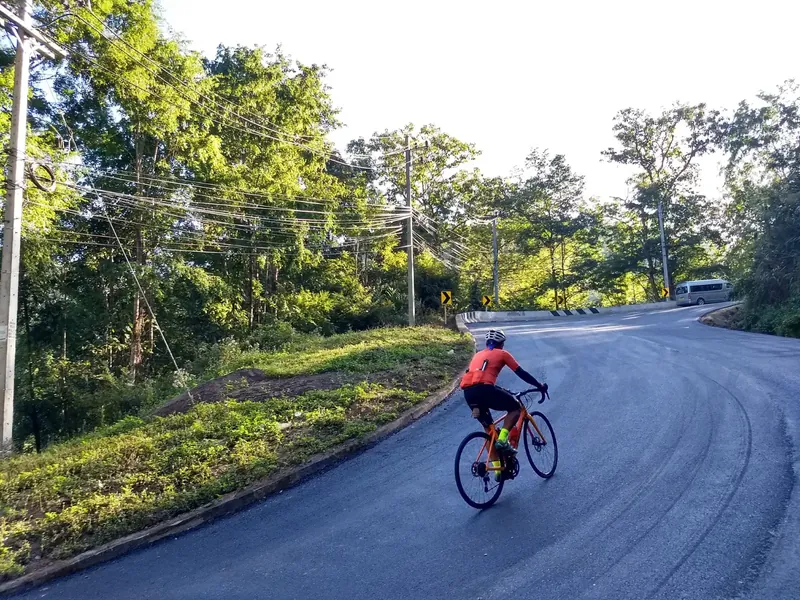
Before choosing where to ride, it is worth deciding how. The same week in the same country can be four completely different trips depending on who carries the bags, who plans the route and who comes to get you when something breaks.
We run supported tours, so read this knowing that. But a supported tour is not the right answer for every rider, and it is better to know that before you book one.
Supported tours
What you get: a planned route, hotels, luggage moved between them, a ride leader, and a support vehicle carrying water, food and spares. On most supported tours the vehicle can also carry a tired rider and their bike. Some have a mechanic with the group. You ride in a group, usually of eight to fifteen.
What it asks of you: very little beyond riding. That is the point. You are not navigating, not finding lunch, not working out what to do with a broken spoke on a mountain road two hours from the nearest bike shop.
The trade-offs: cost, because you are paying for people and a vehicle; fixed dates and a fixed itinerary; and a group whose pace and preferences are not all yours.
It suits: riders who want to concentrate entirely on the riding, riders on their first trip abroad, and anyone heading somewhere remote. Mixed-ability groups, a club or friends of different fitness, work far better with a vehicle behind them.
Self-guided tours
What you get: an operator books the hotels, supplies the route files and usually moves your luggage. Then you ride on your own or with your own group, with a phone number to call if something goes wrong.
What it asks of you: navigation, mechanical self-sufficiency, and making your own decisions on the road. If you puncture twice and run out of tubes, that is your problem to solve.
The trade-offs: cheaper and more flexible, because you choose your pace, your stops and often your dates. But there is no one with you, and on a bad day that matters.
It suits: experienced riders in places where riding independently is easy. Much of Europe qualifies: plenty of bike shops, widespread English, good signage and established cycling routes. Rural Southeast Asia is a different matter. On some of our routes, almost nobody you meet speaks English, and the nearest workshop can be a long way off.
Bikepacking
What you get: freedom. You plan the route, carry everything on the bike, and sleep where you choose: a hotel, a guesthouse or a tent.
What it asks of you: everything. Route planning, carrying the load, finding food and water, and fixing whatever breaks. A loaded bike also climbs very differently from an unloaded one; the same mountain that takes an hour on a road bike can take most of a day with bags.
The trade-offs: the most adventurous and usually the cheapest, but the slowest and the least comfortable. Most bikepacking trips cover far less ground than a supported tour of the same length.
It suits: riders who want the journey to be the whole experience, who are comfortable being self-reliant, and for whom distance and speed matter less than independence.
And one more: the training camp
There is a fourth option that sits between the others. A training camp runs from a single base, with loops every day and no hotel changes. There is support, but it is there for supplies rather than to collect riders, and the group rides together at a set pace. Our Chiang Mai camp works this way. It suits riders building form before a season, not riders looking for a holiday.
How to choose
Ask yourself four questions.
How remote is the destination? The further from bike shops, English and easy transport, the stronger the case for support.
How self-sufficient are you, honestly? Can you fix a snapped chain, a torn tyre and a slipping seatpost at the roadside? If not, either learn before you go or choose a supported trip.
Who are you riding with? A group with a wide spread of fitness is far happier with a vehicle behind it. A pair of evenly matched riders can manage alone. If you are the one organising a club, our guide to organising a club trip abroad starts there.
What is the week for? If it is about the riding, choose the format that lets you concentrate on riding. If it is about the adventure of getting there under your own steam, bikepacking may be exactly right.
There is no wrong answer. There is only the wrong match between a rider and a trip.
If a supported tour sounds right, our tours page shows distance and climbing for every day, and our difficulty grades explain how hard each one is. Whoever you book with, our ten questions to ask a tour operator are worth putting to them.
Written by Barnowl Adventures.